Author: Mike Matthews
Who’s in that Lane for September of 2025?! Johnny Potenza and JP Llanos, that’s who!!
Just a reminder that these Who’s In That Lane! pieces celebrate our club and our teammates, and help us to get to better know our lanemates and the people in those lanes over there! I know we all enjoy being a part of CVMM, and it’s even better when more of us really know each other!
Johnny Potenza
Let’s start with Johnny Potenza! I believe this is our first full other half (I’m not going to use the term better half – who am I to judge?) of a couple where both have been featured in Who’s In That Lane? I’m sure they both consider it a highlight in their relationship. Johnny had never participated in lap swimming before joining CVMM. How did he fill all of those hours as a kid? Well – he played a lot of baseball – eventually pitching on his high school team. And he’s watched every episode of The Twilight Zone plenty of times. But it did mean that Coach Nancy has had to give him a lot of tips on his form. He appreciates them and they are clearly paying off!
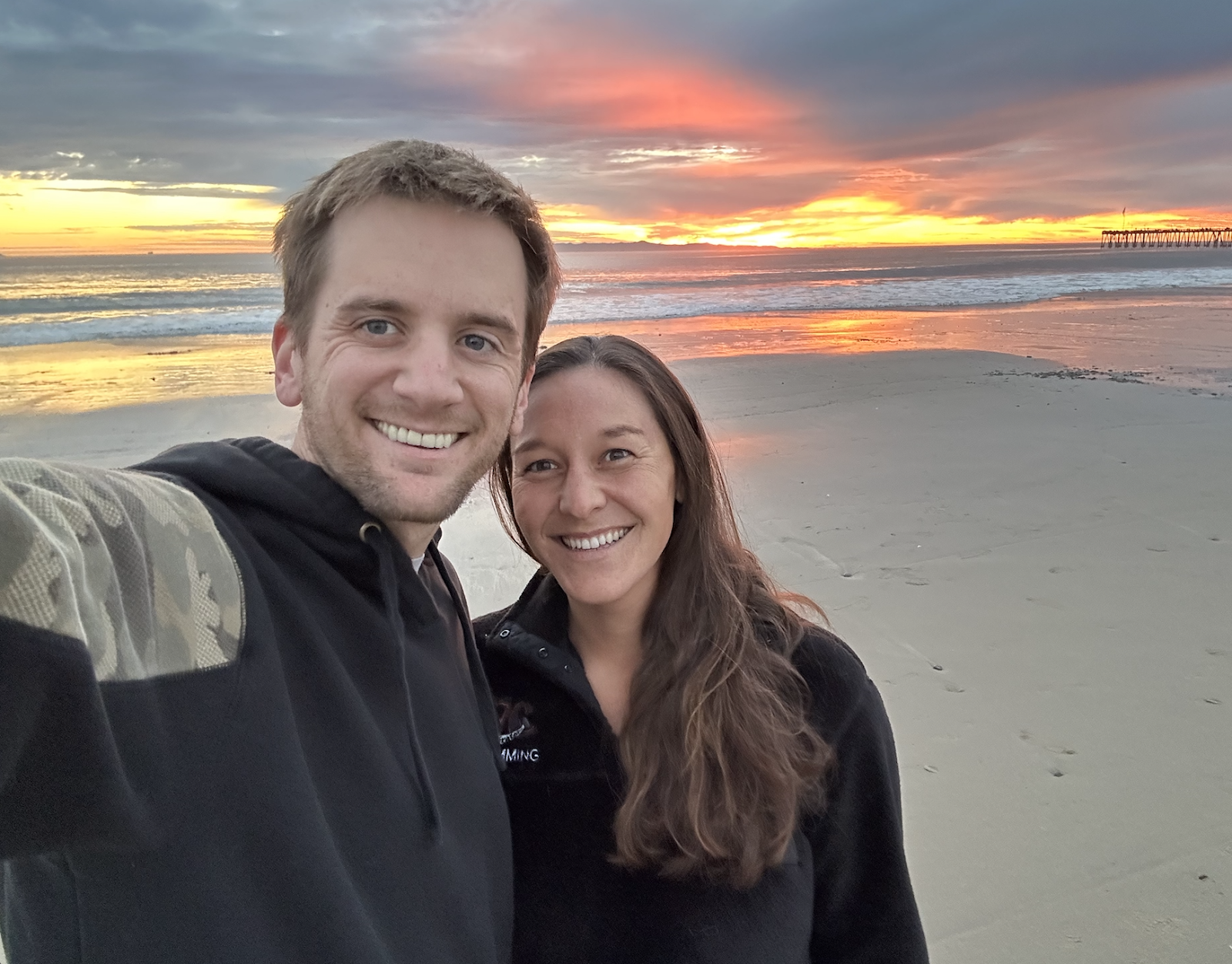
While he’s not yet in Lane 1 with girlfriend and October featured Ali English, he’s now clipping along pretty darn fast – making his repeated 100s on a 1:30 interval. Nice! He even swam in his first meet in Long Beach last December. He said he was super nervous, but enjoyed it so much he wants to do it again. Johnny loves having our CVMM coaches push him and give him tips, and he is always more relaxed after one of our workouts. I prefer the word exhausted, but to each his own! Johnny seems pretty motivated to get into that fast lane, and his trajectory looks good. We are rooting for you.
Outside of CVMM, Johnny has always been an LA guy. Raised in Ventura, earning a BS in Finance at CSUN, working in Simi Valley in the aerospace industry, and a lifelong Dodgers fan. It’s a good time to be a Dodgers fan, right! He’s even seen the Dodgers play in 15 different major league stadiums. Super cool! His future trips will have a lot more stadiums, and plenty of camping at Kings Canyon National Park.
You’ll find Johnny swimming in our MWF evening and Saturday morning workouts. Thanks for being part of us, Johnny. Your commitment and improvement are an inspiration.
JP Llanos
And now to JP! Jean-Pierre (JP) Llanos has been a part of CVMM since 2022. JP is now in his 50s, and one of my favorite things that I have learned is how he described his entry into all things athletic, “I discovered my athletic side when I was 50, never did any sport whatsoever before, and now I am totally addicted to it. Moving to Southern California 6 years ago really helped with that change.” We hear about so many journeys in swimming and athletics that bring us all together at CVMM, and I love JP’s journey.
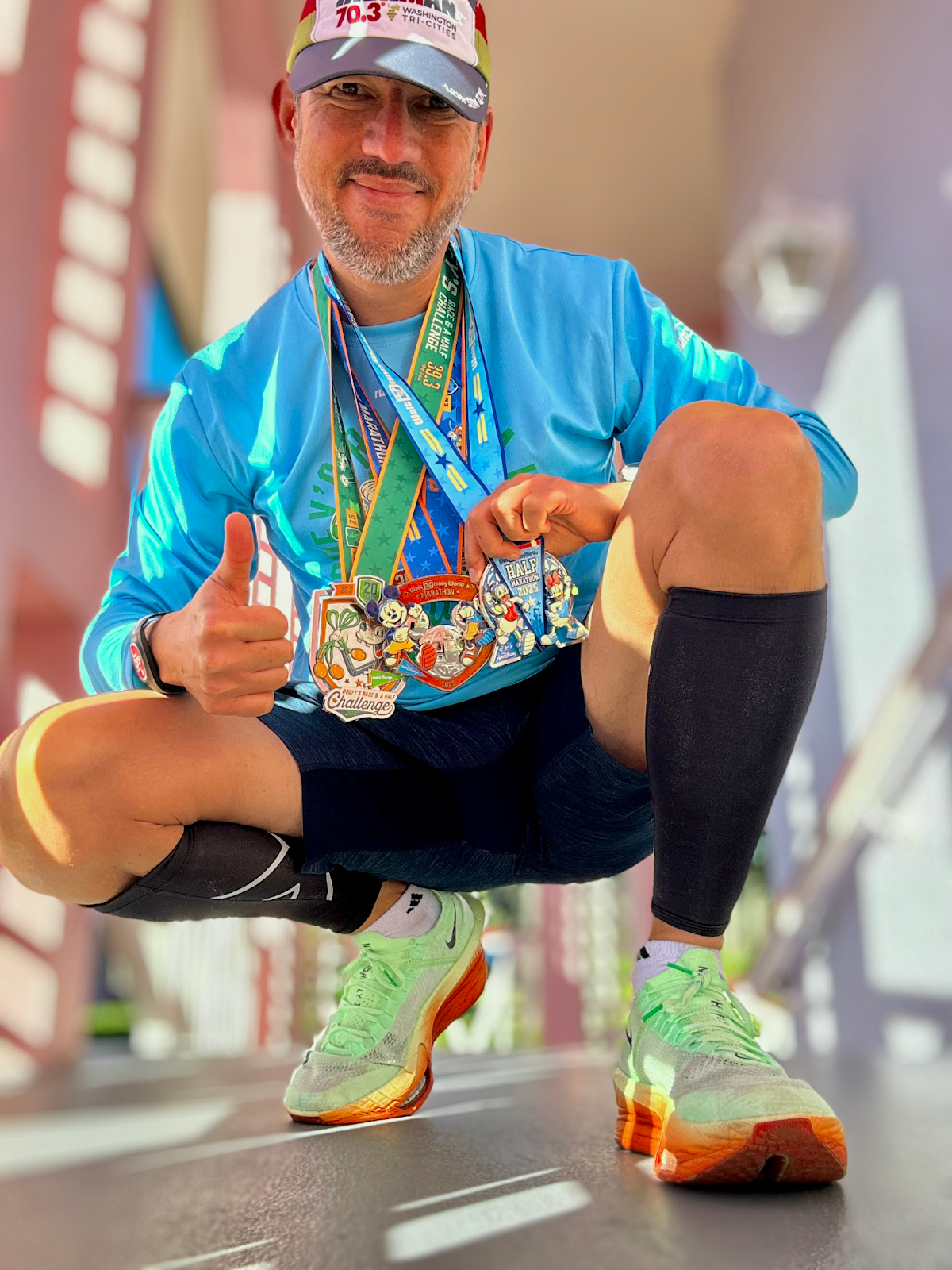
JP’s current athletic journey is focused on 70.3 triathlons. Nothing like going from zero to 80 when you jump into sports. He enjoys swimming with CVMM, particularly in the months before his next triathlon. He is comfortable swimming 100s at a 1:50 pace, and I’m guessing he enjoys our less choppy and much warmer water. Like so many of us, JP enjoys being with friends during our workouts. I’ve said this before, but non-swimmers don’t get how social swimming is. And his favorite set is anything pulling. I have not heard that one yet. He also would prefer to avoid all kicking sets. I’ve heard that one a lot. He has not yet joined us at a swim meet, but he has not ruled it out. I have a feeling that Nancy will wear him down, and he’ll join us soon.
We have a lot of impressive people in our CVMM group, and JP’s career as a Pediatric Pulmonologist and Leader at Amgen puts him on that list. With his Peruvian and German heritage, he finds his time split between three continents. And being a lover of fine food, he gets to experience tri-continental dining as well. I asked JP if he had to pick his favorite continent food, which it would be. JP said it was a hard call, but Europe, and in particular, there’s this one place in Barcelona. . . . He loves his three daughters, and enjoys all the time he gets withhis Frenchie (Chad) at home in Moorpark.
So thanks to our CVMM lanemates Johnny and JP for letting us all learn more about them. Say hello to them no matter what lane you’re in!
To see previous Who’s In That Lane pieces, please click here.
The last time I wrote a post about political influences on education was back in 2021 when I wrote a post about Critical Race Theory (CRT). I was a school superintendent that year, and I vividly recall getting phone calls and emails from parents asking about CRT – I had to look it up in order to answer their questions. I did my research and then wrote a letter to the community trying to answer all of their questions. That blog post was an adaptation of that letter.
Some time after that post was written, I worked for a district that had passed a ban on using CRT in the classroom. In my one year with that district, I was asked repeatedly in public whether I had come across any examples of CRT in the classroom. The answer was always the same – it was a strong and unequivocal “No.”
Still, the fear and worry continued among many in the community.
Our nation’s supposed new enemy is DEI – Diversity, Equity, and Inclusion. President Trump has ordered a halt to DEI programs under federal jurisdiction. At least this time, they are talking about an initiative that, unlike CRT, actually does exist in some of our nation’s schools. Every school I have worked in has made efforts to eliminate racist acts in schools, to support all students in their learning and achievement, and to make every student and every family feel valued and cared about. From what I hear and read in the news, those efforts are now the enemy.
The story that caught my attention was a story about the United States Air Force pausing and reviewing videos and curriculum that taught about and, yes, honored the Tuskegee Airmen, the first and only unit to allow black pilots and airmen to fly in World War II. They also pulled programs about Women’s Airforce Service Pilots (WASPs). New Secretary of Defense Pete Hegseth, when he heard about the controversy, which quickly exploded on social media, made it clear that the military would continue using materials that honor both the Tuskegee Airmen and the WASPs. The Air Force then stated that an “adjusted” curriculum would be reinstated with these videos intact. However, “DEI material” which accompanied this content has been removed.
Here’s the problem: Where is the line between the history and the “DEI material?”
When I taught US history, I made a point to more thoroughly teach truths that were often ignored or glossed over by traditional textbooks:
- Details about the the systematic removal of Native Americans
- The horrors of slavery
- The heroism of Japanese-Americans, particularly those in the 442 unit, who performed incredible acts of bravery while their families remained in internment camps
- The courage of civil rights activists, who endured humiliation, physical injuries, and even deaths while fighting for civil rights
I did not consider teaching those topics courageous back then. But now, it takes some courage to go in depth beyond the paltry coverage they get in normal textbooks. Teachers cannot predict when their classroom conversations on these topics will be perceived as an effort to make students feel guilty for the sins of the past (and I have never met a teacher who sought to do that) or to brainwash students into a “woke ideology” – when they will go from being seen as teachers of history to proselytizers of the DEI initiatives that are under attack. Great teachers do not brainwash. They present information in a compelling manner and help students to think deeply about what they are learning.
Covering those topics does not make teachers less patriotic. We Americans have made mistakes and wronged many people, and though there are still too many wrongs, we have made great progress. My lens in teaching United States history was always that we are the greatest democracy and force of freedom that the world has ever known. I still believe that. I took pride in the fact that my students were always left guessing about whether I was a Democrat or a Republican.
When I worked in the district that banned CRT, I repeatedly encouraged history teachers to talk with their principal if they were going to teach a lesson that some might interpret as CRT, just because of the nature of the topic. And I encouraged principals to call me if they had questions. I have the nagging feeling that, too many times, teachers backed off of topics that might have brought unwelcome attention. I don’t blame them.
I appreciate Secretary Hegseth acting quickly to publicly declare that the suspension of the lessons including the WASPs and the Tuskegee Airmen “has been reversed.” But the confusion and uncertainty has not been completely sorted out, and too much of that confusion and uncertainty will never see the light of day. And this same confusion and uncertainty will be occurring in thousands of classrooms where history and literature from different points of view are being considered. That confusion and uncertainty will create fear, I believe deliberately, and that will have a chilling effect on what teachers feel confident in teaching.
I had the radio on this week, and I switched to a news channel just as President Trump was making remarks about the tragic crash between a passenger jet and a military helicopter, where 67 people lost their lives. Trump began by honoring all of those who died, and by stating that the entire nation mourned each of the deaths. This is what a president should do. – sometimes the president needs to be the “consoler-in-chief.” But then, he pivoted and blamed Obama(!) and Biden for their DEI policies, saying that was the reason for the crash. It was hard to listen to. Very sad. We don’t know the reason for the crash yet. That’s what the FAA investigation is for. But it was a stunning signal that DEI will be the scapegoat for too many things in the years to come. As Dr. Martin Luther King, Jr. said, “Rationalizations and the incessant search for scapegoats are the psychological cataracts that blind us to our sins.”
And what are schools to do when one of our students is the victim of a bigoted act, where they are attacked because of the color of their skin, their national heritage, or their religious beliefs? For me, saying “I’m sorry” was never enough when I met with victims of such hate and/or their parents. Our job in schools is to educate. Hateful acts and statements are NEVER OK, and we have an obligation to teach that. Are the Anti-Defamation League’s “No Place for Hate” campaign or other programs like it DEI initiatives? I don’t know, but I believe some will say that they are. The day we stop protecting students from bias, hatred, and bullying will be a sad day for our schools.
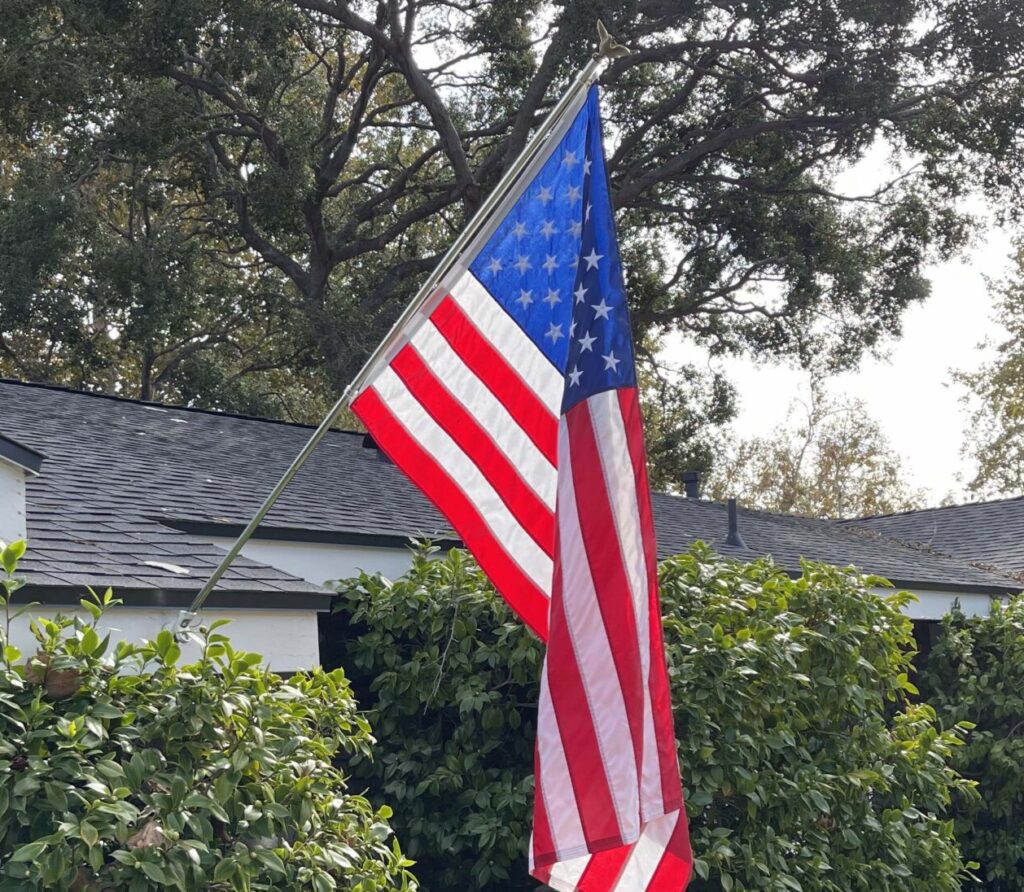
The story of the United States is a fascinating and wonderful tale. And the more fabrics and colors that are woven into the tapestry of our history, the more accurate it becomes. Our nation’s story is more amazing when we consider all of our mistakes and struggles, all of our corrections, and our amazing progress since 1776. I also know that the job is not yet complete. I am proud to be an American, and I fervently believe that the more of us who know our full story, and the more we strive for all of our citizens to be free from hatred and protecting from bullying based on bias, the stronger we will become as a nation.
Thank you, and respectful comments that promote dialogue are always welcome.
Post #126 on www.drmdmatthews.com
If you’re not on the mailing list, you’re missing out. Not only will I let you know when my blog posts come out, but you will get my once-a-month-subscribers-only message. I share what I’m cooking, what I’m watching, what I’m reading, and other news that had a profound impact on me. If you’re interested, please click here.
NOTES
I add these notes sections for a number of reasons:
- First and foremost, many of you are crazy enough to read them.
- My posts are long enough, so believe it or not, I do try to limit them. Ideas that don’t make the cut can end up in the notes section.
- I include additional resources, links, stories, for those of you who want to go a little deeper.
- I may include something from the comments made in my last post, or something I learned in the process of writing this one.
- And remember, the posts are long enough – no one is making you read the notes. (Dad – If you are going to critique me for how long my posts are, please stop reading now. This is the optional part!)
When I taught about World War II, I used Hawaii, one of James Michener’s awesome historical novels. We spent a day in class where I read aloud his tales of the 442 unit. One of the powerful quotes that I remember reading and discussing: “[During WW II, when a Japanese-American unit from Hawaii was fighting in Europe Ernie Pyle asked] “Sergeant, why did you push on against that cluster of houses? You knew it was crowded with Germans.” [The sergeant] replied in words that became famous both in Italy and America: “We had to. We fight double. Against the Germans and for every Japanese in America.” Reported Pyle: “And they’re winning both their wars.” -James Michener, Hawaii, pp. 789-790
It’s a sad day when parents stop reading to their children. I was lucky to share reading with both of my sons through their teenage years. And from my experience, if the reading material is highly engaging, high school students still love being read to.
There has been a lot of talk about DEI hiring processes. Here’s my take on that. Having a diverse work force is a plus. I have always thought that the United States military and professional sports, at least over the last 50 or 60 years, have been two places where people have chances to succeed regardless of the color of their skin. In education, given two equal candidates, I believe the candidate who is less represented in the workforce should be strongly considered. And I have never ever ever hired a less qualified candidate because their race, gender, religious beliefs, or sexual preference.
If you want students to receive the most boring and ineffective teaching as possible, direct them to use the textbook as their only resource. The best teachers adapt curriculum and find materials beyond the textbook that reach students, reinforce concepts, and ignite passions for learning.
Sometimes, a teacher, counselor, or administrator just letting students know that their classroom or office is a safe place where they will not be judged for their race, heritage, or beliefs, can not only provide a much-needed respite in a difficult day for a student, but it can also save lives.
The “consoler-in-chief” term came from quotes from both CNN and Fox. In my lifetime, Carter, Reagan, GHW Bush, Clinton, and Obama were all amazing at the consoling-individuals-and-the-nation-after-a-tragedy part of their job.
Here is my 2021 post on critical race theory.

I love the picture above and found it here.
Source of Tuskegee Airmen photo.
Sometimes the most spectacular sunrises and sunsets appear
when something is terribly wrong in or around our communities.
There is a true lack of coherence in this post. It was written over several days during the fire. I have tried to make it all fit together, but I know it really doesn’t. The lack of coherence kind of jives with trying to make sense of all that has happened since January 7. Thanks for understanding.
We are safe.
Our house is still standing.
But way too many friends and southern California citizens have lost their homes.
I tell myself all the time that I’m ready to lose our house. It is what keeps me sane during the fire season. We should have lost our home in the 2018 Woolsey fire. I will never understand why we didn’t. After the fire, when I stood in my front yard, I could see six houses, some next door, some across the street, that had burned to the ground.
That fire was the first time in 32 years and multiple fires that we actually evacuated. Before that, we had packed many times, but we never actually evacuated. But in 2018, when it became hard to breathe from the smoke, we did leave. The evacuation experience was one of the most frightening experiences of my life. All of the traffic lights were out, and there were zero law enforcement officials guiding traffic. A 20-mile drive took almost six hours, most of it with the fire looming to our left. We were ready to leave our vehicle and run to the ocean. We made it to Santa Monica, but . . . damn. It was rough.
On Thursday night last week, a new fire popped up that quickly spread from 50 acres to 1,000. In no time at all, ashes from the Kenneth Fire were falling in our neighborhood. When I looked at the Watch Duty app that all of us have, I could see the fire, about 10 miles away, and I could see that 30 mph winds were blowing it right towards our neighborhood. If it crossed the 101 freeway like the Woolsey Fire did back in 2018, there would probably be no stopping it.
We had been packed for days, so we loaded up our vehicle and were ready to go. After all the packing was done, I sat down in a chair in our living room and I just tried to take in everything about our house. We have lived in this wonderful home since 2002. We took the house down to the studs in a major renovation project in 2002, and we planned almost every detail in every space in the house. We have taken on several small improvements since then. Ryan lived here from the time he was 12 until he graduated from high school, and Dawson has spent his entire life here. So many memories.
I wondered how accepting I would be of the loss, were it to happen. I know a few things from talking with friends who have lost all of their possessions in fires. You never stop missing the house and the all the big items and small keepsakes that you could not take with you. A good friend who lost his house said that he often would remember an item, and wonder where he could find it, then realized that of course, it was gone. But I have also heard so many stories of life after the fire, whether people rebuild or move, and I know that life will be good again. But there is a lot of pain to get through first. So I would hate to lose it, but as I sat there saying good bye, I felt in my heart I would be OK however it turned out.
But losing the house did not come to pass this time. Air tankers and helicopters doused the fire with force, and forward progress was stopped. I am so grateful.
The news and social media are full of people looking for people to blame. I know that it’s what wins elections, but it is so counterproductive. We need solutions, not blame.
Here are a few truths that I believe:
- Firefighters, both professional and volunteer, are absolute heroes.
- The number of people responding to the Palisades Fire was mind-numbing. Zuma Beach is five minutes from my house. Zuma is almost two miles of wide beaches, just like the ones everyone sees on TV. It is a huge state park visited by millions every year, sometimes receiving 100,000 visitors a day during the summer. Throughout the entire fire, the massive parking lot was full of emergency vehicles from across Southern California, Utah, Nevada, Oregon and of course, Cal Fire. The logistics of taking care of more than 4,000 emergency workers is mind-bending, but it happened.
- It would take gazillions of dollars to upgrade the entire electrical system and put it all underground. Money well spent, but I don’t know who has the pockets and stomach to do it. Because it’s not just a Southern California problem. Oregon, Colorado, and many other states have utilities vulnerable to fire. New and improved infrastructure would save lives in all of those states, and it would save lives and property in flood/tornado/hurricane zones too.
- The fire season is longer than it used to be. I’ve only been here 30 years, but fire season used to be late September to mid-December. Now, it’s longer, and the windstorms are more frequent.
- The winds are worse than they used to be, and the winds in this storm were unprecedented. Two straight days of 40-50 mph winds, with gusts above 100 mph. The warning we all received via text the day before the winds started: “There is an expected destructive, widespread, and potentially life-threatening windstorm starting Tuesday morning through Wednesday afternoon in the City of Los Angeles. Wind gusts are expected to be 50-80 mph and reach 80-100 mph in certain areas. Red flag fire weather conditions will likely continue until Friday.” In that kind of weather,once a fire starts, there is no stopping that fire until it runs out of fuel.
- There is going to be a lot of frustration and headache in the years to come. Insurance is going to be a mess. The permit approval process is going to be an overwhelming bureaucratic task. Finding contractors and construction workers to do all of this work is going to be virtually impossible. A very conservative friend of mine who voted for the incoming president said, “Maybe we should wait on these deportations until this construction work is done.” There you go.
- The most unacceptable result of these fires is loss of life. The final numbers are not known yet, but as of January 17, there were 27 deaths and 18 remain missing.
I’ve written many times about how much I love my neighborhood and the amazing people in it. We have a neighborhood volunteer fire brigade that is highly trained and ready. Some of them, including my friend Emmet, ended up fighting fires far away from our neighborhood, saving homes of people they don’t even know. Emmet is the volunteer who helped to save my house back in 2018. I will be forever grateful. I live amongst courageous and amazing people.

During this fire, our neighborhood lost electrical service, gas service, and Internet for almost 10 days. We would go out into the street to try to glean a little cell service and get updates from each other. The conversations that happened out there were wonderful. There were gatherings and shared meals – some organized, some not – where we shared information and tried to confirm rumors. Many people left to stay with relatives or friends outside the danger zone, and we were all watching out for their houses. At the end of it all, I feel closer to my neighbors and more appreciative than ever of the neighborhood where I live.
Finally, Jill and I have been overwhelmed by the love and support from our family and friends. People were mad at me on Facebook because I was not giving an update on our safety. I had to learn how to do that. Once I did, I was quickly forgiven and supported. I appreciated all of the texts and emails, and tried to respond to all of them when I had service.
As I finish writing this post, the winds are down, the sky is cloudless and blue, and it’s 70 degrees on a mid-January day. It’s why we all stay here.
But I know that incredible destruction is beyond what I can see.
Unlike the fires in 2018, I can’t see the devastation from these fires when I stand in my front yard. I have not seen any of it first-hand yet, but I will. I already know that it will take my breath away when I drive down PCH, or when I drive through Pacific Palisades, and I first witness the remnants of houses and businesses that burned to the ground. But even without seeing it, my heart goes out to all of those who have experienced loss, several of whom are readers of this blog. I’m so sorry. Those blank spaces left by the fire were homes to millions of memories and loving moments.
It will take time, but we will rebuild. Again. We will do it together. Again. And I will be on the side of people seeking support for the victims and solutions for the future.
Post #125 on www.drmdmatthews.com
If you’re not on the mailing list, you’re missing out. Not only will I let you know when my blog posts come out, but you will get my once-a-month-subscribers-only message. I share what I’m cooking, what I’m watching, what I’m reading, and other news that had a profound impact on me. If you’re interested, please click here.
NOTES
I add these notes sections for a number of reasons:
- First and foremost, many of you are crazy enough to read them.
- My posts are long enough, so believe it or not, I do try to limit them. Ideas that don’t make the cut can end up in the notes section.
- I include additional resources, links, stories, for those of you who want to go a little deeper.
- I may include something from the comments made in my last post, or something I learned in the process of writing this one.
- And remember, the posts are long enough – no one is making you read the notes. (Dad – If you are going to critique me for how long my posts are, please stop reading now. This is the optional part!)
- Pictures of the fire are from Emmet Pierson. Amazing. Thanks for sharing, Emmet.
- Pictures of smoky sunrise and sunset are mine. Pollution and smoke make for stunningly beautiful beginnings and ends to each day. Not worth it.
- My friend Chris, a real writer, posted a spectacular piece of writing about these fires just this morning. It’s well worth the read.
- As I scrolled through Facebook this morning, I saw a post from my friend Bill, a wonderful teacher and musician, that reinforced my thoughts about losing homes and stuff. I thought it was great.
- Having been through the Woolsey Fire six years ago, I have let go of my teddy bear that was 70 years old, in a drawer I forgot to check. The kids movies we forgot to pack. Miles of Ampex tape full of decades of music. The this and the that . . . gone. You have to finally come to terms with the permanence. All that you lost is still stored in your brain’s master filing cabinet. You can visit occasionally . . . just like you visit loved ones you lost. You’ll be OK.
- If you don’t know where to donate, please consider the Boys and Girls Club of Malibu. They are connected to the Malibu community and they know where the true needs are.
As I end my 2024 year, I find myself spending 90% of my time in my own home, most of it cuddled up with my newest and favorite possession – my ice machine that provides soothing relief to my new knee. I love my ice machine. Don’t get me wrong, I love spending time with my family, but it’s way easier to tolerate me as a husband and father when I spend a lot of time with my ice machine.
I’m a New Year’s resolution guy. I always have been. Apparently, less than a third of Americans set resolutions, and the older we are, the less likely we are to set them. Numbers be damned – I’m still setting them. I fail more than I succeed, but I like setting the bar a little higher than where I am now.
For a couple of years now, I have been wrapping up my new years resolutions into one word. My 2023 word was self-disclipline. And I began this year choosing the word masterpiece. I am finding that those two words are incredibly intertwined, and that you really cannot have one without the other.
I have been pondering what word(s) to choose for 2025. In doing so, I was reminded of goal setting while I was superintendent in Manhattan Beach. The most important tasks of an elected board of education is to determine the direction and goals of the school district, and to hire a superintendent who can make progress towards those goals. In my eleven years with Manhattan Beach, our goals remained remarkably consistent – be fiscally responsible, help our students to be healthy and well-adjusted, improve student mathematical achievement, and develop students into better readers and writers. Then, we picked methodologies to help us achieve those goals, and we stuck with those methodologies as we sought to incrementally improve each and every year.
There are lots of ways to achieve your goals, but I strongly believe that you only make true and sustainable progress if you follow Jack Welch’s advice: “In real life, strategy is actually very straightforward. You pick a general direction and implement it like hell.” I was lucky to work with a board that understood that, and stood steadfast in its commitment to slow and steady improvement, year after year.
So I am going to mimic Jack Welch and my old board (many who are blog readers!), and stay the course in 2025. My key word will again be self-discipline. Without it, there is no way I can be wildly, or even moderately successful at making each day a masterpiece. If I can make self-discipline a bigger and more constant process in my life, I just may have that occasional masterpiece.
Those of you who know me well are keenly aware that this is a reach for me. I am easily distracted (squirrel!) and I am constantly working to refocus. One of the keys to golf success is fully concentrating for fifteen seconds as you are making each shot. Fifteen seconds! Anyone can do that. And yet I fail so often. “All” it takes is being present and being intentional. All I know is . . . I can be better.
Making each day a masterpiece does not just mean getting a lot of stuff done. In fact, it can be the opposite. Here are some aspirational thoughts, as well as some pitfalls to avoid.
- I’ve been coming across many quotes from poet Mary Oliver. I’m not sure why she’s popping into my life right now. Here’s a recent one that my friend Nicole shared with me called Instructions for Living Life:
Pay Attention
Be Astonished
Tell About It
- It takes tremendous self-discipline to slow down, pay attention, and see all of the wonder that is in our daily lives, and to seek out experiences that will foster more wonder. My mother-in-law has made this her main focus over the past few years, and it’s making her pretty darn happy. I’m in.
- I want to avoid, as much as possible, activities that would be classified as “brain rot,” the Oxford Dictionary’s “word of the year.” OK Oxford – maybe it should be the “term” of the year, because two words are not one word. But overlooking that, this is the term that Oxford believes best encapsulates 2024. Their definition: “the supposed deterioration of a person’s mental or intellectual state, especially viewed as the result of overconsumption of material (now particularly online content) considered to be trivial or unchallenging.” My guilty endless scrolling pleasures are Apple News and Facebook. I need to be self-disciplined enough to limit myself. Life is too short for brain rot.
- I still believe in the paper checklist. I know I am better when I use one. Over the past two years, I’ve been printing out and utilizing a checklist four days a week on good weeks, and far fewer days on less disciplined weeks. I want to make this part of each day, so I can make the most of each day, reflect on each day, and plan for tomorrow.
- I want to learn from masters of self-discipline – Steven Covey, John Maxwell, and my friend Rick Lopez, who may be the most intentional, self-disciplined, and joyful person with whom I have ever worked.
- John Wooden spoke of this masterpiece idea repeatedly (Jack Welch should have used Coach Wooden as the perfect example of steadfast implementation), so there are quite a few quotes attributed to it. Here is one that I found, and any of us could substitute a line or two or three to this, as we all have our own version of a daily masterpiece. That being said, this one is pretty darn good:
Be true to yourself
Make each day a masterpiece
Help others.
Drink deeply from good books.
Make friendship a fine art.
Build a shelter against a rainy day.
Pray for guidance and give thanks for your blessings every day
So that’s my focus for 2025. I’m seeking to stay the course, minimize brain rot, improve my self-discipline, and I’m hoping for as many daily masterpieces as possible.
And all the while, implementing like hell.
I hope that the new year brings you good health, joy, love, fulfillment, astonishment, and an abundance of reasons to smile.
Post #124 on www.drmdmatthews.com
If you’re not on the mailing list, you’re missing out. Not only will I let you know when my blog posts come out, but you will get my once-a-month-subscribers-only message. I share what I’m cooking, what I’m watching, what I’m reading, and other news that had a profound impact on me. If you’re interested, please click here.
NOTES
I add these notes sections for a number of reasons:
- First and foremost, many of you are crazy enough to read them.
- My posts are long enough, so believe it or not, I do try to limit them. Ideas that don’t make the cut can end up in the notes section.
- I include additional resources, links, stories, for those of you who want to go a little deeper.
- I may include something from the comments made in my last post, or something I learned in the process of writing this one.
- And remember, the posts are long enough – no one is making you read the notes. (Dad – If you are going to critique me for how long my posts are, please stop reading now. This is the optional part!)
The New Year’s greeting picture is from our summer trip to Hawaii – From the left, greetings from Mike, Jill, Dawson, Kylie, Ryan, and Yesi.
I said I wouldn’t write about this in every post, but for those of you interested, here’s my knee replacement update, 3.5 weeks after my surgery.
- After two weeks, no more walker or any other assist devices, walking 7000 to 9000 steps (3-4 miles) a day and increasing; longest walk so far is 1.25 miles
- Physical therapy twice a week
- 110 degrees of flex in the knee – goal is 140 or more
- Off of all narcotics after two weeks (If they had been more effective, I might still be on them.)
- You know that feeling you get when you have a good stretch? According to my physical therapist, that’s not enough. It has to hurt
- Sleeping has gone from terrible to bad. Progress!
- Normal activities are returning – I’m now able to drive, cook, clean, and enjoyed grilling outside on Thursday. I used the Christmas prime rib leftovers to make Phllly Cheesesteak Sandwiches for Dawson and his friends. Big hit!
Here are some of the links I referred to:
Last Tuesday, I had my full knee replacement surgery. Those of you who are regular readers knew this was coming. I tried to share the information without being obnoxious about it. Pushing the limits of that not being obnoxious goal, I thought I would share a few thoughts about the surgery and the first two weeks of my 4-to-6-month recovery process, mixed in with a few of the themes I have hit in previous blog posts.
- I’ve never been cleaner than when I went into surgery. They make you shower with a special heavy duty anti-bacterial soap three times before you make you way to the hospital to check in. OK. Maybe I was cleaner one other time. I was midway through a five-week bike ride across Europe in 1982, and we stopped at Baden-Baden in (then) West Germany. We paid a few marks and got to experience their famous and ancient baths. But before I was allowed to enter, I had to spend 10 minutes being soaped up and scoured by a person I named Bernhard Bristlebrush, a large German man who enjoyed the task way more than he should have. But man, I was clean.
- My knee was replaced by Dr. Erik Zeegen and his team at UCLA Santa Monica. Every interaction was professional, kind, clear, and even enjoyable. And so far, the follow up has been caring and responsive. Jill and I are beyond impressed. In every interaction, I felt like the UCLA employees were proud of being on the UCLA team. They lived up to the UCLA Vision: Our Vision is to heal humankind, one patient at a time, by improving health, alleviating suffering, and delivering acts of kindness. I’ve written about kindness and the power and beauty of working on a unified team. My gratitude for each team member in helping me through this is overflowing.
- In most cases these days, a full knee replacement is outpatient surgery. I checked in at 6:15 AM, had the surgery at 8:30, received training on walking (using a walker) and getting in and out of a car, and I was out there by 3:30 PM. Wow.
- The team said the surgery went well. I received my X-rays the next day. Pretty good improvement, right? I think my old knee (above left) looks like an angry Harry Potter Sorting Hat.
- The ice machine is my friend. I am probably icing for half of my waking hours.
- I shouldn’t write this, but my previous experience with Oxycodone was fantastic. I had broken a finger in multiple places, and the doctors were trying to set it. It was terribly painful, and all of the sudden, it wasn’t. Nothing mattered. That’s when I learned that opioids, unlike anything else I’ve ever taken, are so good that they are dangerously addictive. In an odd way, I was looking forward to briefly returning to that no pain and nothing matters state. Alas, it was not the same. It just made me tired. Extremely disappointing, and probably for the best.
- The best anti-pain treatment I had this time was called a nerve block. They insert a needle into my thigh above my knee before the surgery, and they attached a device that pumped anti-pain juice into my leg every two hours, effectively keeping my brain from realizing my knee was in pain. Wow. That thing worked. Unfortunately, long term use can cause problems, so it came out three days after the surgery. I miss it.
- Jill has been a rock star, and our marriage is still intact. I hope that both of those things continue. Our shared household duties ratio has slightly altered from 49 (me)/51 (Jill) to about 0 (me)/100 (Jill). I’m occasionally cranky, and, on top of doing everything, she has the unenviable added task of making sure I’m not doing things I should not be doing. My brother Bill told me that three or four days after his knee replacement surgery, the drugs were making him feel just fine, so he decided he should go out and pressure wash the driveway. Nothing bad happened, but his lovely wife was not happy with him at all. Thanks, Jilly for keeping me in line and for all of the help! We usually don’t exchange gifts during the holidays, but I think I owe her something big.
- I don’t hate my physical therapist . . . yet. Right now, I have a 45-minute routine that I try to do five times a day to help my leg straighten out and bend like it used to. I start with a 20-minute walk, then do 10 minutes of stretches, then I get on a special machine that I am renting for 8 weeks, which uses a cycling motion to help my ligaments and muscles adapt to the new knee and to regain flexibility. It’s doable, and I don’t hate it yet. It’s my newest and most important routine, and I plan to prioritize it every day.
- One of UCLA’s mottos for orthopedics is, “Movement is Medicine.” I like it. I feel best when I am walking the 30 steps through our living room and down our hallway, turning around and doing it again, and again, and again. Right now, each walk is about 0.33 miles on the world’s shortest track. So if I’m doing that five times a day, I’m at 1.5 miles a day or so. Excellent!
- And if movement is indeed medicine, then stillness, at least long stretches of it, is the opposite. Getting up, shifting positions, and moving makes me feel less stiff. This surgery is solely intended to give me the opportunity to be fully active for the next 20 years, and I know it will take getting out of my chair and being active, suffering now so I won’t suffer later, to make the most of it.
- Sleeping is a challenge. It’s always a challenge for me, and being a pain wimp makes it even more of one. Luckily, everyone knows that getting quality sleep doesn’t matter at all for recovering from injuries.
- I wrote a blog post a while back called “Do Something Every Day that Sucks.” If that’s my mantra for success, then all I have to do is my daily rehab activities. Winning!
- I am not alone. They do about one million knee replacements a year now in the US. I am on the younger side for having it. My friend Rhonda had her surgery a week after mine. She has already told me that she’s going to win our recovery contest. I didn’t even know it was a competition! And how do you win? I’ll do my best, but I’ve already accepted that she will stop at nothing to leave me in her dust.
I promise I won’t be writing about this in each of the next 18 blog posts, but it’s kind of a big deal in my life right now, so I thought I would share this time. I considered sharing a journal where I describe the recovery process each day, but after doing it for a few days, I was boring myself. Suffice it to say, so far so good, I feel very cared for by my medical team, my family, and my friends, I’m trying to be a more patient patient at home, and to remember that slow and steady wins the race.
Have a good day, y’all, and your comments are always appreciated.
— Mike
Post #123 on www.drmdmatthews.com
If you’re not on the mailing list, you’re missing out. Not only will I let you know when my blog posts come out, but you will get my once-a-month-subscribers-only message. I share what I’m cooking, what I’m watching, what I’m reading, and other news that had a profound impact on me. When I send out the November Mid-Month Message next week, it will have recipes and thoughts about Thanksgiving. If you’re interested, please click here.
NOTES
As I send this, firefighters, both professional and volunteer, are wrapping up their efforts on the Franklin Fire, the latest fire to hit Malibu. I know people whose homes were damaged, and I know far more whose homes were saved. Unlike the Woolsey FIre in 2018, when there were so many fires in southern California that firefighters could not fully attack on all fronts, the response to the Franklin Fire was overwhelming. As I drove down the highway yesterday, there were still hundreds of fire trucks and repair vehicles, base camps for firefighters, and so much more. My heart goes out to those whose lives have been uprooted, and my gratitude is full for the professionals and volunteers who made a difference.
This fire never got closer than 6 or 7 miles from our home. We did lose our electricity for two days, but we have a generator that can keep the bare necessities going. We are far more used to that than I would like to be. Thanks to so many of you who reached out to check on us. We were lucky this time.
As I wrote this post, the fact that I have health insurance that will cover most of these costs is not lost on me. Health insurance is on every front page these days, and it is extremely troubling. The US leads the world in health care innovation and research, but our costs and our insurance issues are problems. The Affordable Care Act has helped millions to gain insurance, but I only see that weakening in the next few years. My wife and I are both long time public school employees, and we know how fortunate we have been to have health insurance over all of those years. I know this: we can be better as a nation when it comes to health insurance.
I’ve said this before, but I’ll say it again. One of the many purposes of these blog posts is to motivate myself. By sharing the things I know I should be doing (see list below for starters), I have one more reason to actually do them. I fall short every day. And I get back on the horse. I began the year talking about John Wooden’s Make Each Day a Masterpiece. I have made serious efforts to do that on many days, and on many days it got away from me. And even on my best days, I doubt you would see my effort hanging in the Getty Museum. That being said, I want to lead my best life and be the best that I can be, and I’m hoping for a good day today.
Some of my blog posts that I referenced above:
I hope you all had an outstanding Thanksgiving. I certainly did. It remains my absolute favorite holiday.
Highlights of my Thanksgiving included:
- Having the meal ready to serve at exactly 2:00 PM
- Everything turned out really nicely
- Ryan did a fantastic job cooking the Brussels sprouts on the new Blackstone griddle
- I did my annual pie trade, giving away a chocolate pecan pie to my friend Quinton in return for her famous Carrot Cake. I know. Not a pie. But it is legendary and delicious. Pretty sure I won that trade.
- Leftovers were abundant and frequently served
- Beautiful weather, with dolphins and whales making appearances at the beach
- Games of all sorts were played and enjoyed
- Successful travel for my sons and my sister, and in my four trips to LAX, I only had to battle terrible traffic once
I am a free subscriber to Maria Shriver’s Sunday Paper email. It is reflective, kind, and positive, all things that I’d like to have more of in my life. In her email on the Sunday before Thanksgiving, she shared some thoughts from Phil Stutz on how to create what he calls, “grateful flow.”
I’ve written about flow before, and I used Mihaly Czikszentmihalyi’s original definition: “It is the state in which people are so involved in an activity that nothing else seems to matter; the experience itself is so enjoyable that people will do it even at great cost, for the sheer sake of doing it.” Phil Stutz has taken that concept and applied it to a way of thinking he calls “grateful flow.” Here are his instructions.
Close your eyes. For about 30 seconds, say aloud a handful of things you are grateful for in that moment. The smaller the things are, the better. By example, I would say, ‘I’m grateful I had a good lunch. I’m grateful for my car that’s working. I’m grateful I have a nice piece of furniture to sit on.’ Put your energy into saying each thing you are grateful for.
Put your will into saying these things. By reciting small things you are grateful for in the moment, you actively anchor yourself in immediate reality. You are also choosing your thoughts instead of being passive about them and letting them take over.
After you’ve said what you’re grateful for, stop talking. The goal now is to feel what you just said and experience an energy rising in you. That is the grateful flow.
It is a meditation-induced flow. I like it. And you just need 30 seconds. I made several efforts this week to do just that. I did my best to express and reflect on gratitude for the little things. As I look back at the week, here are some of my major gratitude themes.
We live in a medical marvel of a world. We have not yet cured dementia-related illnesses, damnit. But I’m getting my knee replaced today, hopefully allowing me to be pain free and enjoy the upcoming decades with fewer physical limitations. My Dad and I were talking about another eye surgery he had last week. He knows that if he had been born just fifty years earlier, he would have lost his sight years ago. We all have the opportunity to live longer and better in today’s world, and from what I read, AI is only going to make that better.
Family and Friends. Like so many of you, I spent my Thanksgiving with family and friends. Both of my sons were home. I spoke to each of my family members in Arkansas and Washington. I reconnected with friends in the neighborhood and a few who live thousands of miles away. I know I am fortunate, and it’s nice to take time and reflect on my blessings.
Physical activity. Over the past week, I played pickleball twice, golfed twice, and swam three times, and my knee did not like it at all. But I did. I have not taken any of that activity for granted, as I will be unable to do those things for a few months while I recover from the surgery. Physical activity is such a great part of my life, and I hope I can continue it for many years to come. No matter how long, I’m grateful that it is part of my life right now. The friendships that it provides and the goal-setting that it injects into my life definitely make life richer. To all of my golf, pickleball, and swim friends, I will see you soon!

Billy Mitch My friend Billy Mitch passed away this week. I’m doing my best to find gratitude for having him in my life for the last 48 years, but so far the sadness is holding that gratitude back. But I’m trying. The world has a big hole in it where he used to be. On the surface, he was one of the most hilarious human beings I’ve ever met. I’ve written about him in these posts. He was always the MC at our high school reunions – which really meant that he did a one hour improv comedy routine that was the highlight of our awesome reunions. By my calculations, at least 35% of his comments were appropriate. Billy Mitch was a legendary and larger than life human being. He was a big man in high school and remained so his whole life. And his persona and his heart were even bigger. He was gifted behind a camera. His most recent artistic job was creating videos honoring fallen FBI heroes. My brother had the privilege of working with Billy Mitch to support families of those heroes by auctioning off a special flag painting. Billy Mitch connected with those families, just like he found ways to connect with all of us. He was something. I know that like me, his classmates and other friends will remain grateful for Billy Mitch until our last day. He made us care about each other, laugh while doing it, and look forward to whenever we would see each other next. Thank you, Billy Mitch. You were one of a kind, my friend.
The Present I woke up in the middle of the night this week feeling anxious about my upcoming surgery. I know that’s natural. My life is going to get turned upside down for a little bit, before it gets right side up and better than before. Most of us experience anxiety, but all of the experts are saying it is a sickness gripping our nation like never before. I believe it was Eleanor Roosevelt who said, “Yesterday is history, tomorrow is a mystery, today is a gift. That is why they call it the present.” And I’ve often cited Eckhart Tolle’s The Power of Now as a wonderful reminder that so much suffering can be avoided if we just keep making the effort to focus our minds on the present. I often open that book and review my highlights and notes. Here are two that I reflected on this week to help me with my grateful flow.
All negativity is caused by an accumulation of psychological time and denial of the present. Unease, anxiety, tension, stress, worry – all forms of fear – are caused by too much future, and not enough presence. Guilt, regret, resentment, grievances, sadness, bitterness, and all forms of nonforgiveness are caused by too much past, and not enough presence.
As soon as you honor the present moment, all unhappiness and struggle dissolve, and life begins to flow with joy and ease. When you act out the present-moment awareness, whatever you do becomes imbued with a sense of quality, care, and love – even the most simple action.
I hope that Stutz’s grateful flow idea is helpful to you. Thanksgiving week was a highly appropriate time to use that reflection and calming tool. But the truth is, any time, including right now, is a good time.
Thanks for reading.
Post #122 on www.drmdmatthews.com
If you’re not on the mailing list, you’re missing out. Not only will I let you know when my blog posts come out, but you will get my once-a-month-subscribers-only message. I share what I’m cooking, what I’m watching, what I’m reading, and other news that had a profound impact on me. When I send out the November Mid-Month Message next week, it will have recipes and thoughts about Thanksgiving. If you’re interested, please click here.
NOTES
My blog post was not published on a Saturday this time. I’m sending it out on Tuesday morning – exactly 72 hours late. I was enjoying my friends and family a little too much to take time away and get out the post on time. As we say in pickleball when we win a point by hitting our opponent, “Sorry . . . Not Sorry.” (Unless of course you hit them above the shoulders, something which deserves a quick and real apology.)
Notes on the Billy Mitch Chandler pics above. The pic on the top left is a recent pic of him – I don’t know where it came from – but it’s great. The picture at the bottom is a few of us at the end of our 40th high school reunion in 2021 – delayed one year by Covid. You may notice Billy is pretty much front and center. And the picture on the top right is a recent picture – taken earlier this year on one of my trips to Little Rock – at a crappy bar with cold beer and bad food. None of that mattered. Only Billy Mitch could get away with that hat. We laughed and reconnected, and that picture makes me very happy. And very sad.
Maria Shriver’s Sunday Paper. (11/24)
I mentioned the FBI fundraiser that my brother Pat supported, thanks to Billy Mitch’s connection. Here are some photos about that event from my brother’s art website:

I received a “care package” in the mail this week. I didn’t know how much I needed it.
Care packages are best received when something is not normal in your life. Examples include times when you are away from loved ones, you are going through a difficult time, you are recovering from a physical or emotional injury, half of the nation is preparing for a Constitutional crisis . . . you know, the usual stuff.
I have been lucky enough to receive a variety of care packages over the years. I remember getting them from my mom during my four-week Ozark Boys Camp where I spent my summers when I was 10, 11, and 12. My dad always sent me letters, and I loved them. But care packages blew the door off those letters (sorry, Dad). Getting a package with candies and homemade cookies to share with my cabin mates was always a great thing. It felt like the warmth and love in my home was right with me in our woodsy cabin. And it made me popular for about 83 seconds, which is how much time it took us to gobble up everything.
Being in college 2000 miles away from home was another opportunity for my mom to send care packages. In my freshman year, she actually sent me a German chocolate cake through the US mail for my birthday. I think it took over a week to get there. That no-preservatives-week-old cake, all beaten up by the US mail process, was perfect. It looked and tasted like the love and care I was missing from home.
Our children received care packages from my mom (their grandmother) over the years, and they always loved them. There’s something about opening a package and finding candy, pictures, toys, cool t-shirts, and whatever else struck my mom’s fancy. It’s not their birthday. It’s not Christmas. It’s just . . . because. If Forest Gump is right, and he always is, and life is indeed like a box of chocolates, then a care package is like an additional little box of chocolates that suddenly appears within that big box of chocolates.
I have always described my mother as the definition of unconditional love. And her infatuation with care packages was just one of a million examples of how she displayed that love for her children and grandchildren.
No care package has come to our home for a long time. Over the past decade, my mother’s health has declined, and she is no longer able to put together and mail a care package. That is the least of our concerns, as her health and her dementia issues continue to worsen. The disappearance of care packages is just one of so many losses we have experienced with her decline.
I hadn’t even thought about care packages for so long.
Then out of the blue, my brother Pat sent me a care package. That’s a first.
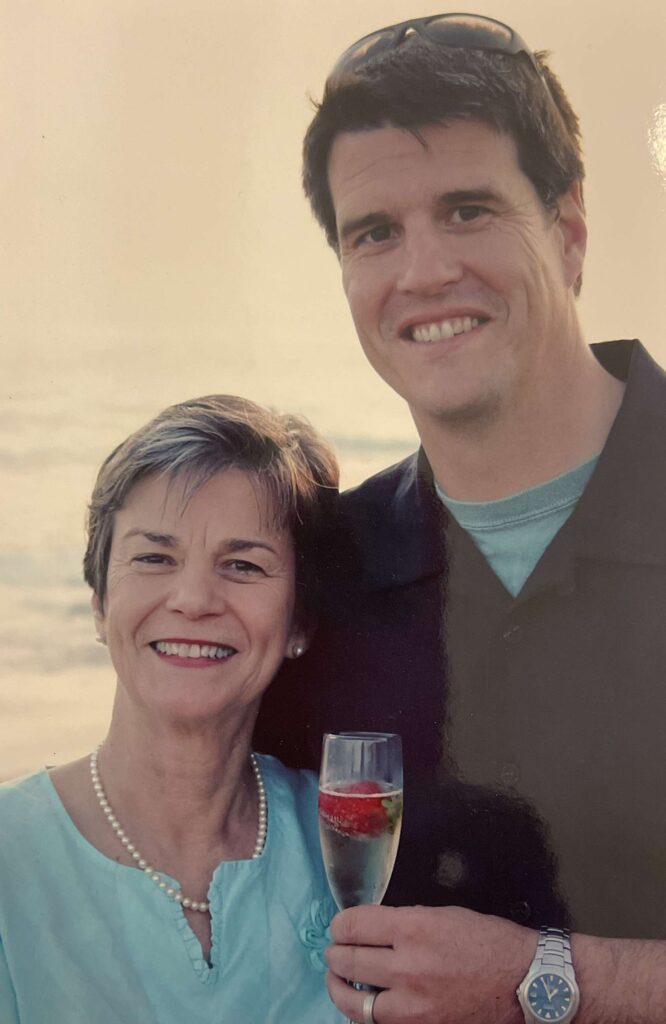
I had left a hoodie on my most recent visit to Arkansas. Just the fact that he returned the hoodie deserves a small parade. But, as the ads for Ginsu knives would always say, “But, wait! There’s more!” He included his favorite coffee pods that he enjoys every day. He included a picture of my mom and me taken back in 2005 that I had not seen before. He included a funny and touching note. He even included a new t-shirt that he loved, and therefore, so do I.
I was so touched by the fact that he took the time to put it together, package it, and send it in the mail.
And I found myself flooded with memories of care packages full of love that my mom sent for me and for my children over the years. I miss having that random parcel of love and care in my life.
Care packages are acts of kindness, and I think kindness may matter more now than ever. Politics and media are sorely lacking in kindness these days. Bullying is more in vogue than I can ever remember. I try to keep mean people out of my life. But it’s harder than ever.
That’s why my brother’s act of kindness hit me so deeply. My mother’s ability to spread her love is severely diminished, and we need to make up for that loss. And her love was so extensive, that it will take many of us to fill that void.
Care packages come in many forms: A quick note or text of appreciation; an unexpected favor; small gifts of some kind; sharing a plate of cookies or mini pumpkin pies when you’ve “accidentally” made too many. And sometimes, it’s just the gift of time.
So thanks, Pat, for reminding me about something that had been missing in my life, and for leading by example. There is more need than ever for love and kindness in our world. I will try to pay forward the love and care I have received.
Post #121 on www.drmdmatthews.com
If you’re not on the mailing list, you’re missing out. Not only will I let you know when my blog posts come out, but you will get my once-a-month-subscribers-only message. I share what I’m cooking, what I’m watching, what I’m reading, and other news that had a profound impact on me. When I send out the November Mid-Month Message next week, it will have recipes and thoughts about Thanksgiving. If you’re interested, please click here.
I will be publishing this post as a podcast after I post it here. The podcasts are based on the post, as I reflect on what led to the writing, or reflections afterwards, or debates I was having with myself as I wrote, or, well, I never quite know until I do it. If you would like to subscribe to that podcast, please click here, or you can follow me on Apple Podcasts.
NOTES
I loved my three summers at Ozark Boys Camp. Four weeks of being in a cabin named after a baseball team, where we did nothing but sports and activities all day. Lots of baseball (I came in 2nd in the home run derby – 10 pitches and I hit 1 home run. There were about 8 of us tied for second), water skiing, swimming, broom hockey, basketball, hiking, archery, rifle shooting, arts and crafts, decent food, and the great feeling of going to sleep exhausted every night. And every Sunday, 95% of the boys attended church and vespers, and they loaded the other 5% – the Catholics – on a flatbed truck and took us into town for afternoon Mass. Bonus – we got ice cream after! But 4 weeks? What were my parents thinking? They were crazy like a fox, because I loved it all.
Boxes from Amazon Prime that you order for yourself, no matter how many, do not count as care packages.
For those of you who don’t remember the Ginsu knives ad, it was kind of the original infomercial in my life. I found one of the ads on YouTube, and it’s better than I remember. Why would you ever need to cut through an aluminum can? And the price, for all of that stuff, is way lower than you would expect, even with inflation. For the record, $1 in 1980 (when that commercial was filmed) is worth about $4 in 2024 dollars. Here’s the ad.
Also, even though care packages were better received, Ozark Boys Camp was the beginning of my dad’s efforts to write me a typed letter almost every day when I was away at camp, and even when I went to college. I still have a number of them, and they mean even more now. Thanks, Dad.
The photo at the top is from ChatGPT. It’s always an adventure to get that image as correct as possible. In my prompts to ChatGPT, I listed the items I’d like to see. But it kept on adding a cup of coffee. I would instruct it to repeat the picture, but take out the coffee. Then there would be two cups of coffee. I used all caps, and that resulted in an apology, but the coffee was still there. Eventually, and this is now a pattern, I give up, and ChatGPT wins. Maybe that’s a small metaphor for our future relationship with AI.
The picture of my mom and me that Pat sent was totally new to me. That alone is an incredible gift. It was taken on a local beach here in Malibu in 2005 at my sister Martha’s wedding. In that picture, my Mom is 64 and I am 43. She looks way better than my 62-year old self, and I don’t look 43 any more. What a precious memory. Also, damn, does time go fast. Let’s enjoy today, my friends!
I guess I’m not a very good sports fan.
I was not one of the two million fans screaming and cheering on the streets of LA as the Dodger World Series victory parade drove through town yesterday. I was not part of the packed Dodger Stadium that gave a thundering welcome to the Dodgers at the end of the parade. I was not one of the people arrested during the course of the celebration, nor did I start any fires or commit any crimes. But I did at least read about all of it after it happened. That counts for something, right?
Don’t get me wrong. I love sports. When I was a kid, I would wait for my dad to finish with the sports section of the newspaper, then read it from back to front. I would watch anything sports-related on TV – baseball, golf, football, World’s Strongest Man, Superstars, Wide World of Sports, boxing . . . I think you get the drift.
If you lived in Arkansas, you were automatically a Razorbacks fan. Football was and is king, but basketball was pretty good back in the late 1970s, too. I’ve been gone from Arkansas for 44 years, and I’m still a Razorback fan. But here’s the thing. Am I really a fan?
The word fan stems from the term fanatic. And the definition of fanatic that I’m going with is Oxford’s, “a person filled with excessive and single-minded zeal.” Back in my childhood days, I rooted for the St. Louis Cardinals baseball team, and against the Dallas Cowboys. And my favorite pro football team, for whatever reason, was the Miami Dolphins. I had Miami Dolphins pajamas, a Dolphins bedspread and trash can, and a poster of quarterback Bob Griese on my wall. That was kind of fanatical.
I remember making a bet with my 5th grade friend RoseAnn (Hi RoseAnn! Thanks for being a blog reader!) on Super Bowl VI, as I was sure my favorite football team, the Miami Dolphins, would trounce the Cowboys. Nope. 24-3 Cowboys. Mike lost $5; RoseAnn won $5. To top it off, she and I were finalists in the spelling bee, and she beat me by correctly spelling the word chrysanthemum. I’ve gotten over the spelling bee, but the Super Bowl loss still hurts. She has reminded me of both losses on several occasions. It’s been 52 years, RoseAnn. Enough already!
But my fanaticism has faded away over the years. When I moved to Northern California, I became a Stanford fan, a 49ers fan, and a San Francisco (baseball) Giants fan. I went to a few games, and the Joe Montana years were absolutely wonderful.
Then I moved to Malibu, and I started taking my son Ryan to Dodger games. Ryan’s grandfather had access to amazing tickets above home plate, and we got to attend at least five games a year. We loved it. Then, three years in, the Dodgers played the Giants. I thought it only made sense to put on my Giants cap. Ryan goes, “Dad? Um. What the heck are you doing with that cap? Don’t we hate the Giants?”
That’s when I realized I’m not a very good fan. At that time, I still liked the Cardinals, I loved the Giants, and I was learning to love the Dodgers. But most of all, I was a fan of my son, and I did not want this rift between us. So I bought a Dodgers cap and became a Dodgers fan. (And a Giants fan. And a Cardinals fan.)
I reserve my bitter disdain for two teams – the Dallas Cowboys (I can’t really explain it, but it’s real), and the low-down-cheating-World-Series-stealing Houston Astros. If this were not a family publication, there would have been an f-bomb in there. But that’s it. Just those two teams. As a Stanford alum, I’m supposed to hate UC Berkeley. But I don’t. I went to graduate school there for a year, and I think Berkeley is an outstanding university. It makes no sense that Stanford and Cal are both in the ACC, and I will root for both of them when they play Duke and North Carolina.
If you take away the excessive and single-minded zeal part, are you really a fan?
Back to the Dodgers – It was amazing to see them win the World Series this week. Jill and I watched every game on TV. Tape-delayed of course. My friend and across-the-street neighbor Jack (also a blog reader) has lived in our neighborhood for almost 60 years. When I asked him about watching the World Series, he said he was looking forward to it, then casually added that he’s been a Yankees fan since 1941, and that will never change. Now there’s a fan. There was not an ounce of compromise in his voice. I bet he enjoyed the Yankees winning that one game, and I bet those 3 errors in the 5th inning will haunt all Yankee fans for a while. Of course, Jack has seen the Yankees win 19 World Series during his lifetime, so he probably doesn’t feel too bad.
I am comfortable in my current state of loving sports but embracing a “casual fan” attitude that keeps my mood from being negatively impacted by my teams’ successes and failures. I never watch live sports on TV. Who has three hours? If I record it ahead of time, I can zoom through it in an hour, and if it’s not close, I can just stop watching. The only commercials I ever see are during the Super Bowl, and they are outstanding!
There are, of course, people who call themselves fans, who take it too far. The two Yankee fans who assaulted Mookie Betts after he had caught a foul ball have been unapologetic afterwards. The fans who get into fights with fans of another team, just because they are wearing the wrong jersey. That kind of negativity and hate has no place anywhere. They are not fans – they are ugly people looking for a fight. An attorney friend of mine says he thinks Mookie Betts owes it to baseball to file assault charges. That kind of behavior cannot be part of baseball games. By the way, the Yankees gave those two a whopping one-game suspension. I hope those miscreants are not treated as heroes next year.
So to all of the real sports fans out there, to all of you diehards who support your team no matter what, and to all of you who keep that fan energy positive, I apologize for falling short in my fanaticism. And I will say that watching the games is better because of true fans who show up, who spend way more money than they should on season tickets, and who live and die by their team. All of you make the games more interesting to us lesser sports fans.
In summary, Go Hogs! Go Cardinal! Go Bruins! Go Orediggers! Go Cardinals! Go Giants! Go 49ers! Go Rams! Go Lakers! Go Warriors! And . . . Go Dodgers! And – Beat the Cowboys and I hope those low-down cheating *#^@* Astros don’t win it all for a long time.
Post #120 on www.drmdmatthews.com
If you’re not on the mailing list, you’re missing out. Not only will I let you know when my blog posts come out, but you will get my once-a-month-subscribers-only message. I share what I’m cooking, what I’m watching, what I’m reading, and other news that had a profound impact on me. I heard back from many of my subscribers about October’s Mid-Month Message, and I am most grateful. If you’re interested, please click here.
I will be publishing this post as a podcast after I post it here. The podcasts are based on the post, as I reflect on what led to the writing, or reflections afterwards, or debates I was having with myself as I wrote, or, well, I never quite know until I do it. If you would like to subscribe to that podcast, please click here, or you can follow me on Apple Podcasts.
NOTES
I was not a professional wrestling fan as a kid, nor am I now. My brother Bill has had a lifelong love affair with the WWF/WWE, but not me. Though the Ric Flair 30 for 30 episode by ESPN was absolutely fantastic, and I admit that I occasionally give a Ric Flair yell when things deserve celebration.
- Post publication update – My brother Bill let me know that he was not a WWF/WWE fan growing up, though he is now. He and his crazy friends were fans of the old Mid South Wrestling with characters such as General Scandar Ackbar, The Junkyard Dog, and Kamala the Ugandan Giant! That’s even better, Bill!
If you don’t know how the Astros cheated their way into winning the 2017 world series, you can read it in Wikipedia here.
The funniest jokes are the ones you have to explain. So, I made a hilarious reference above to the San Francisco (Baseball) Giants. Let me explain. Back in the 1st half of the 20th century, New York had the New York Giants football team, and the New York Giants baseball team. So when you referred to the Giants, you had to clarify whether they were the baseball Giants or the football Giants. The baseball Giants moved to San Francisco in 1958 (the same year the Brooklyn Dodgers moved to LA – tough year for NY). Fast forward to 60+ years later, and some people still refer to the NY Giants football team as the New York (football) Giants. It’s a humorous nod to history. So when I said, the San Francisco (baseball) Giants, it was a takeoff on that humor, which to me, makes it even more hilarious.
I also think that explaining that the funniest jokes are the ones you have to explain is funny in itself. Let me explain. . . . OK. I’ll stop. But I do want to explain it. Because it would be even more hilarious.
Also, before the New York team was the Giants, they were the New York Gothams for three years. Batman would have liked that.
I have spent over thirty years in educational leadership roles. I enjoyed so many aspects of all of my jobs. I loved the hard work, strategic planning, supporting teachers and staff, communicating with parents and garnering their support, developing collegial relationships, and so much more. And the longer that I worked in leadership positions, the more I enjoyed the mentoring aspect of my job. Supporting leaders in difficult situations, being a confidential listener for leaders who needed to get stuff off of their chest, celebrating successes, and most of all, just knowing what made leaders tick – all of that became more and more important to me over the years. In the last half of my 39-year career, it was mentoring others that did the best job of filling my bucket.
As I look back on my career, I had many mentors. I also did a great job of hiring people who were more intelligent and more talented than I, and they often advised and mentored me in my job, even though I may have technically been their supervisor. Many of those amazing colleagues are now readers of this blog, and I can feel them nodding their heads, saying something like, “Damn right I was smarter and more talented. He was lucky to have me!”
Yes I was, and thank you.
In my mentoring roles, I do my best to prepare the leader for a challenging situation. But in crunch time, leaders need to lead. I remember a very heated situation where I offered to stand alongside a talented leader as he faced a very difficult meeting with a large group of parents. In very strong terms, he refused the offer, saying this was his battle. I told him I would be two minutes away during the entire meeting, ready to assist if he texted. He told me he would not need that. I waited nearby during the meeting, and of course, he did not contact me. He did an outstanding job at that meeting, and that person is still leading at very high levels today.
That type of situation, where I support, but allow others to be the point person, sometimes made me feel like Marlin Perkins, the famous star of the 1961 – 1986 show, Mutual of Omaha’s Wild Kingdom.
I remember manually turning the dial to channel 4 (NBC) on Sunday evenings to watch Wild Kingdom with my family. Marlin Perkins was an accomplished zoologist, and he and his younger assistant, Jim Fowler, also a highly talented zoologist, showed me a world far different than my own. I loved it.

Johnny Carson loved to rib Perkins for putting Fowler in the path of danger while Perkins watched from a distance. Carson would mimic Perkins’ voiceover, saying,, “While Jim gives the mountain lion an enema, I’ll stay at the camp and mix daiquiris,” Or perhaps, as others have put forth, “Wolverines are some of the most vicious animals known to man, which is why Jim’s the one down there with only a net,” or even, “While Jim is wrestling that pissed off Cape Buffalo, I’ll be in the helicopter scouting crocodiles for him to tackle next.” I love it.
Even though I sometimes thought of Marlin Perkins, I knew it was the only way. Mentors cannot do leaders’ jobs for them. Leaders need to lead.
One way to look at effective mentoring is to compare it to a golf caddie. A caddie, who is often a very high level golfer, knows the golfer extremely well and walks side by side with her or his golfer. When it comes time to make decisions and execute the best shot possible, the caddie knows whether to be quiet, offer limited advice, or go into a full-fledged debate about what the best course of action is. The caddie may have experience that the golfer does not have, or the caddie may know that the golfer already has all of the information she or he needs to hit the perfect shot. While it is the golfer who faces the most intense pressure, and it is the golfer who either delivers an outstanding shot or makes a mistake, the caddie is by their side offering coaching, support, or consolation for every move the golfer makes.
Here is what I constantly advised educational leaders: There will be times when you have to make quick decisions. But there are other times leaders face significant challenges, when they have the time to reflect, to weigh options, and to look at the long run. In those situations, leaders have the ability to play chess. Why would a leader do that alone? Why would he or she not consult a caddie, seeking out a mentor, a legal expert, other leaders who have faced similar situations, a communications expert, or anyone else who can assist them? Having a caddie-like mentor, someone who knows the leader and their context and uses that knowledge to walk by their side, gives leaders confidence as they face a challenge. When I had options and when I had time, that’s exactly what I did.
When I was reflecting on a situation that was so complicated that it required legal assistance, I sometimes asked the attorney what I could have done differently to avoid or lessen the crisis that I had faced. Too often, their answer was, “You could have called me first.”
We usually have more time than we think.
Unless something is literally on fire, we can give ourselves permission to slow down our minds, take time to ponder options, phone a friend, or consult that coach, team member, or caddie who helps us to think. Leaders cannot avoid facing difficult situations, but they can feel less alone as they face them.
As a principal facing a challenging situation, I sometimes, at least initially, felt like Jim Fowler. I was on my own, and my mentor/boss/caddie was out of sight, just like Marlin Perkins. But in reality, I did not feel alone. In almost all cases, I felt like I was going into battle fully supported by my mentors . . . by my caddies. It was up to me to do my best, based on my experience and all the advice I had internalized, and in doing so, I did not feel alone.
So thank you to all types of mentors and experts who supported me and gave me strength as a leader. And to those I have helped and continue to assist, it is my honor to do that. And to all of us, as we wait until the next challenging situation we face, let’s try not to feel alone as we face it. And to all of you leaders out there facing difficult situations now and in the future – go out there and wrestle with that alligator!
Post #119 on www.drmdmatthews.com
If you’re not on the mailing list, you’re missing out. Not only will I let you know when my blog posts come out, but you will get my once-a-month-subscribers-only message. I share what I’m cooking, what I’m watching, what I’m reading, and other news that had a profound impact on me. Thanks to all who let me know you appreciated it. If you’re interested, please click here.
And something new, I am publishing this post in podcast form a few days after I post it here. The podcasts are based on the post, as I reflect on what led to the writing, or reflections afterwards, or debates I was having with myself as I wrote, or, well, I never quite know until I do it. If you would like to subscribe to that podcast, please click here.
——-
NOTES
Jim Fowler appeared on my favorite Seinfeld episode ever. It’s the one where Kramer finds the old Merv Griffin set in a New York dumpster and sets it up inside his apartment. Jim Fowler plays himself, and he crushes it. (Episode 6 in Season 9, #162 – available on Netflix)
Here’s a scene of Marlin Perkins wrestling an anaconda. I don’t know why he felt he had to get in the water and mess with that beast. I have read that some of these supposedly wild animals may have actually been quite tame. But it’s still great TV, especially for a 10-year old.
Here is an interview of Jim Fowler, saying that Perkins was far more involved than he was portrayed. It’s worth the 2-minute watch.
Sometimes, a principal would apologize for taking my time in bringing a problem to me for discussion. I forget where I heard this, but my response was something like, “You are an outstanding leader, and you can solve 99% of the problems you face without a problem. For you to come to me, it must be a big one. Let’s figure it out together.”
And I thought I would share some quotes on not needing to feel alone, especially in difficult situations.
- Those are the same stars, and that is the same moon, that look down upon your brothers and sisters, and which they see as they look up to them, though they are ever so far away from us, and each other” — Sojourner Truth
- I am a part of all that I have met. — Lord Tennyson
- Remember you are never really alone. Although it may feel like it for very long stretches of time. — Steven L. Peck
- Walking with a friend in the dark is better than walking alone in the light. (Helen Keller)
- Dark and difficult times lie ahead. But remember this, you have friends here. You’re not alone. (Albus Dumbledore)
- Compassionate Friends is a support group that helped me tremendously after the death of my 4-year-old son, Sean. Here is their credo:
- We need not walk alone. We are The Compassionate Friends. We reach out to each other with love, with understanding, and with hope. The children we mourn have died at all ages and from many different causes, but our love for them unites us. Your pain becomes my pain, just as your hope becomes my hope. We come together from all walks of life, from many different circumstances. We are a unique family because we represent many races, creeds, and relationships. We are young, and we are old. Some of us are far along in our grief, but others still feel a grief so fresh and so intensely painful that they feel helpless and see no hope. Some of us have found our faith to be a source of strength, while some of us are struggling to find answers. Some of us are angry, filled with guilt or in deep depression, while others radiate an inner peace. But whatever pain we bring to this gathering of The Compassionate Friends, it is pain we will share, just as we share with each other our love for the children who have died. We are all seeking and struggling to build a future for ourselves, but we are committed to building a future together. We reach out to each other in love to share the pain as well as the joy, share the anger as well as the peace, share the faith as well as the doubts, and help each other to grieve as well as to grow. We Need Not Walk Alone. We Are The Compassionate Friends.
Photo of Perkins and Fowler by Missouri Life magazine.
Photo of golfer facing a mountain of a challenge with a supporting caddie by ChatGPT.
Who’s in that Lane for October of 2024?!
Ali English and Clark Trainor, that’s who!!
Just a reminder that these Who’s In That Lane! pieces celebrate our Conejo Valley Multisport Masters Club and our teammates, and help us to get to better know our lanemates and the people in those lanes over there! I know we all enjoy being a part of CVMM, and it’s even better when more of us really know each other!
The picture above was taken just before the Wednesday evening workout. As you can see, Clark and Ali are joyful and happy to be in the pool, even though they’re about to swim everything Coach Nancy plans to throw at them. I love it!
Let’s start with Ali English!

Ali has been a CVMM team member since April, 2022. She joined to get back into swimming after graduate school. In her words, she loves the, “camaraderie with others as we tackle challenging workouts together.” I love that. Sometimes, the lanemates do have a ‘we can get through this together’ attitude during a tough workout. I think we have all shared a fistbump with a lanemate once a particularly difficult workout or set is completed.
Unless her work as an urgent care physician assistant gets in the way, which, obviously, just by the nature of the job, it does sometimes, you’ll find Ali at the M/W/F evening workouts, and the Saturday morning workout. As for why she shows up to our workouts? “I find swimming as an outlet for my day-to-day stress, but I enjoy goofing around with my teammates between sets. I show up at the pool to get stronger and faster, but I also come for the social aspect of swimming. I love that post-swim rejuvenated feeling that comes after doing a hard workout.” I wish I could speak or write that well about anything. Nicely said, Ali.
Ali swam competitively at Ventura High School (Go Cougars!) and at UC Santa Cruz (Go Banana Slugs! BEST MASCOT EVER!). And as a competitive bonus, Ali is the first person I’ve ever met who competed in Modern Pentathlon. The “only” skills you need for that are freestyle swimming*, fencing, equestrian show jumping, laser pistol shooting, and cross country running. Wow. She’s been riding horses since she was 7 years old, and usually rides at least one of her three horses (Mac, Ben, or Ivor – he’s pictured below) before the evening workout. So cool.
* In case you’re wondering, the swim in the modern pentathlon is 200 meters. You get 250 points for a time of 2:30, and you get an additional 2 points for each second faster than 2:30. Also, Ali pointed out that CVMM’s Rachel Coleman also is a modern pentathlon-er athlete. Wow!
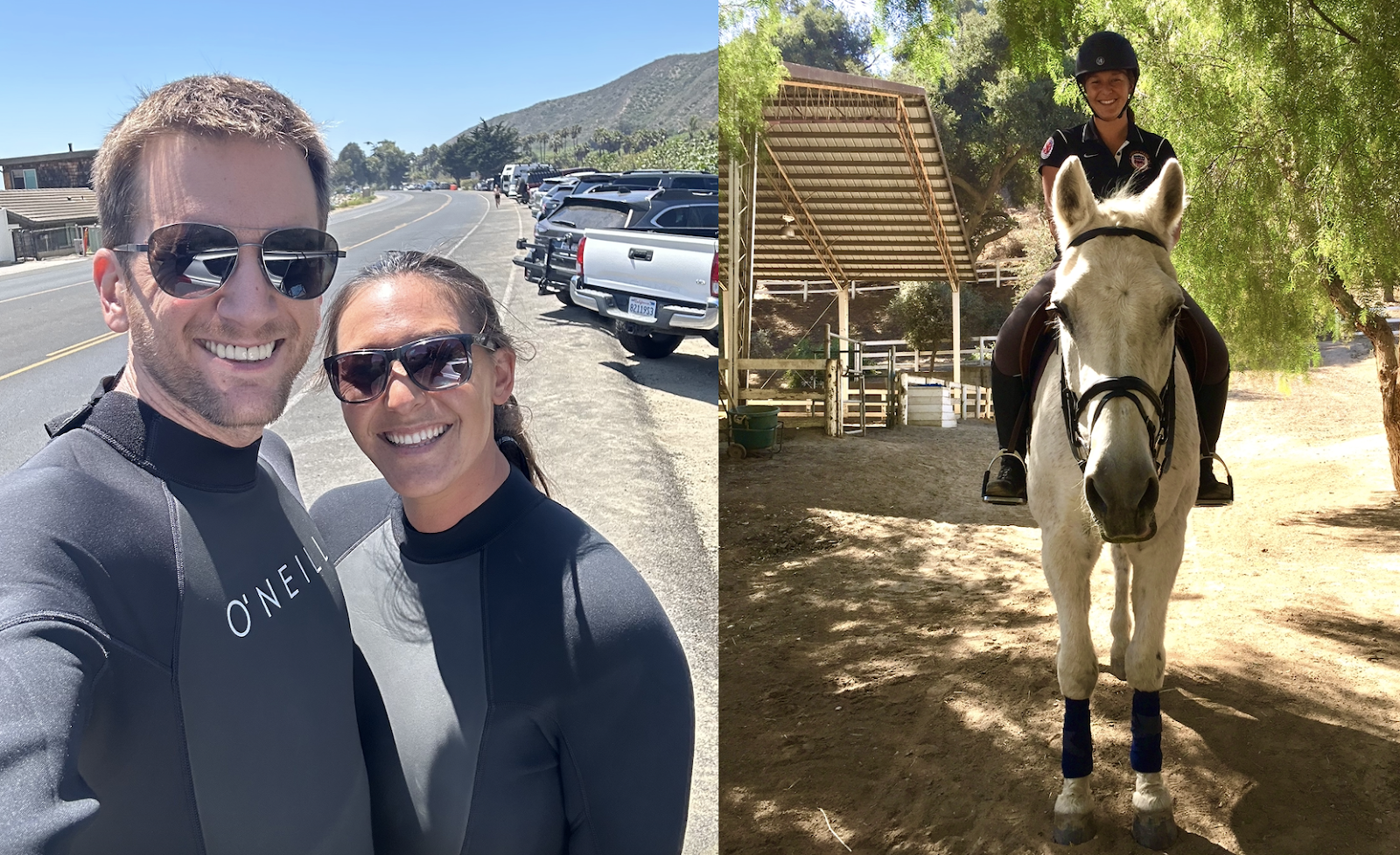
You’ll find Ali in Lane 1. If she has to, she can swim 5 x 100 yards at a blistering 1:10 pace. But what she really loves are distance sets. I respect that, but I don’t understand it. Her boyfriend, John Potenza (pictured above, he’s the one without the long face), is also a CVMM member and is working hard to earn his way to swim in the same lane as Ali. Keep your eye on the prize, John, and good luck to you!
And now, Clark Trainor is in that lane!
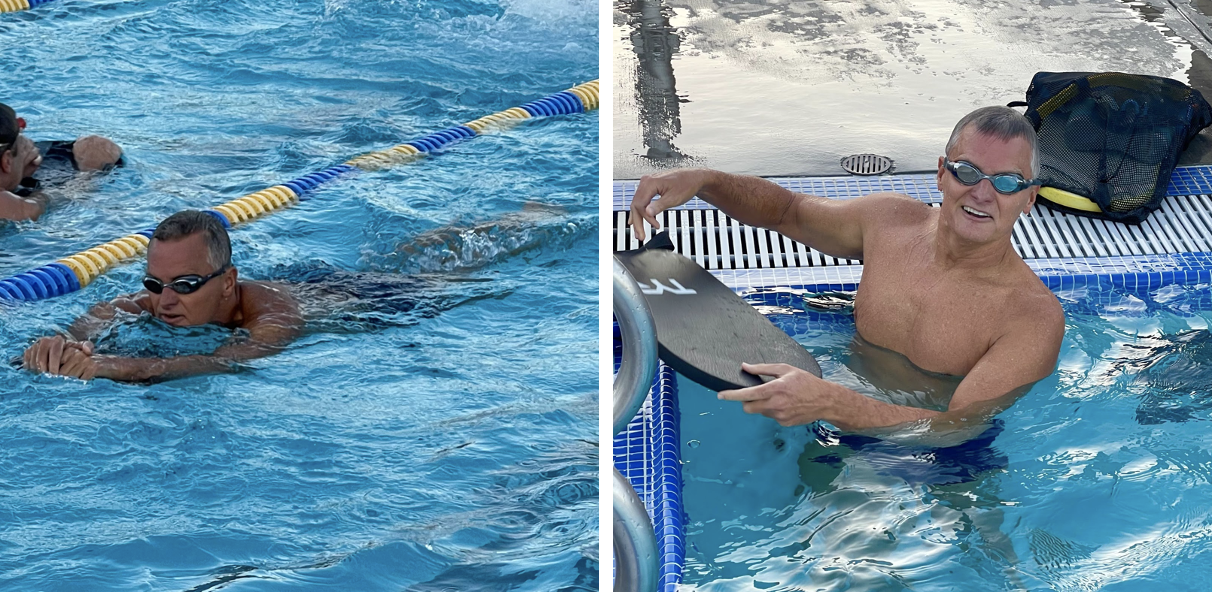
Like Ali, Clark joined CVMM in April of 2022. Unlike Ali, it had been 34 years since Clark last swam competitively. That’s a long time! He spent those 34 years in a happy marriage, raising three big and talented boys, and maintaining a wicked sense of humor. If you’re in Clark’s lane, get ready for some humor. It’s coming whether you want it or not. For me, lane humor is always appreciated. We need something to get us through together!
Clark started CVMM workouts for the fitness, but has come to love the camaraderie. He also believes his marriage will thrive if he manages to get out of the house every once in a while. I get that, Clark – I just don’t say it out loud.
Clark’s favorite set is the last one of practice. That is funny. But given a choice, show him the sprinting! 9 x 50 with varying speeds, and he loves competing against whoever is next to him. Well said, Clark. Sprinting is the preferences of the wisest of us. I don’t know what people like Ali are thinking with their love of distance.
Clark avoids any practice that combines cold and dark. So though he might do evenings in the summer and early fall, he will transition to afternoon workouts when the days are shorter and cooler.
Clark swam for an Olympic coach at one point in his storied career. Of course, he was only seven years old when he swam for Jack Nelson in Fort Lauderdale, Florida. But he did swim for a short time at Drexel College in Philadelphia (Go Dragons!). Now, Clark says he can do 5 x 100 on a 1:20 pace. (Watching him swim with Ali in Lane 1, I’m pretty sure he could do 5 at 1:10 – he’s fast!). Whatever the time, he has kept that 7-year old raw talent even with that long 34-hiatus.
Clark brings so much to CVMM – his appreciation of family, his swimming history, his ever-present self-deprecating humor, and a joyful spirit. Look for him and say hello!
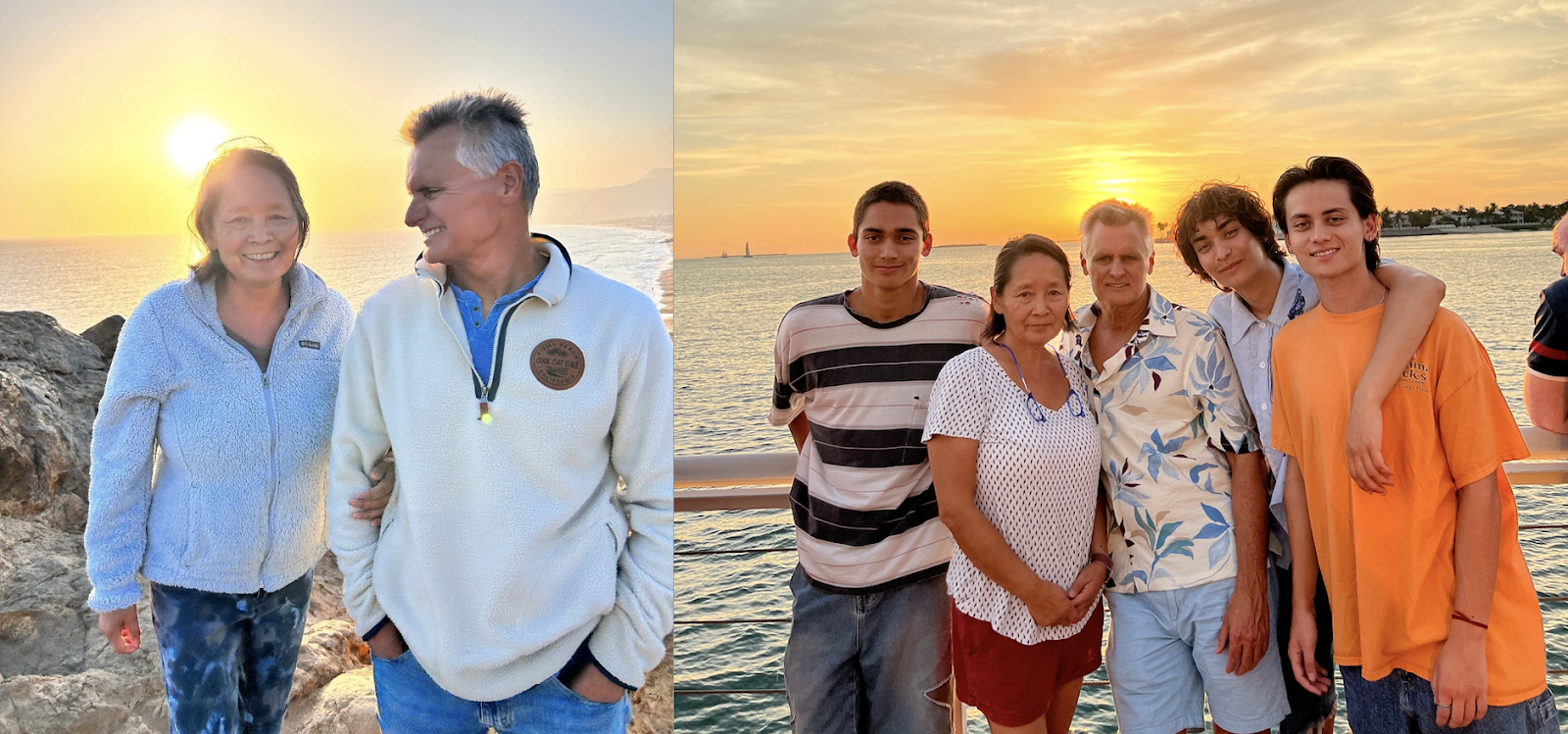
So thanks to our CVMM lanemates Ali and Clark for letting us all learn more about them. Say hello to them no matter what lane you’re in!
To see previous Who’s In That Lane pieces, please click here.
One of the greatest aspects of retirement is that, for the most part, I don’t really have to do anything that I don’t want to do. I don’t have to go to work. I don’t have to write these blog posts. No one is telling me how to spend my days. I can wake up each day and blissfully exclaim, “I wonder what I’m going to do today!”
It’s a far cry from how I spent my working days. I woke up ridiculously early to swim in a masters workout. I’d would fill my work day with meetings, problem-solving opportunities, and enjoyable visits to campuses, and I would fill each empty moment with planning for the next day, the next week, the next board meeting, and the next year. In my time away from work, I would sneak in grocery shopping, professional and pleasure reading, phone calls to family, family dinners, and a lot more.
I worked 50-60 hour weeks, yet somehow found time to get almost everything done. In fact, like many retirees I know, I often think, how did I get so much done while I was working? And why do my days feel so full now that I’m retired?
I think it’s the power of routines that make us so productive. When we are used to a 4:30 AM alarm, it’s just part of what we do. The 5:30 AM workout is another non-negotiable routine. If I could go to the grocery store on the way home, I would make it happen. When I was not talking to Board members on my one-hour plus commute home (Hi Karen! I miss our long conversations filled with business and laughter), I was talking with family members, and sometimes using the time to catch up with my wife. All these routines made me incredibly productive.
In my retirement, I have to develop new routines. That blissful wakeup scenario I mentioned earlier would not work well for me. In certain areas of life, routines are critical. And now, in my second year of retirement, I am still working to establish those routines.
I recently went on an 8-day trip to Chicago and Little Rock. I loved it! I worked with and was inspired by incredible superintendents in Chicago, and I spent four days in Little Rock visiting family. I wouldn’t trade it for anything. That being said, my 70-minute workout on my first day back home, after weighing in five pounds above my departure weight, was more minutes than I spent working out during the entire 8-day trip. I don’t usually eat biscuits and gravy for breakfast, but I love it, and I had my share on this trip. With a little more effort, I could have written a book titled, “How to gain a pound a day on your travels.”
Needless to say, I was eager to get back to my retirement routines.
I don’t want routines for everything. But I think I need them in certain areas. Here are the areas where daily routines allow me to lead my best life:
- Exercise
- Hydrating and Eating Healthy Food
- Showing appreciation and affection to loved ones
- Reflecting on my goals
- Keeping my home environment neat and tidy
The first four of those posts are adapted from a post from Edward Sullivan. The last one is my relatively new influence from Marie Kondo (I can feel many of you rolling your eyes). I now know that when I’m not in a peaceful and neat environment, my life feels a little out of control, and it’s hard for my mind to focus.
These routines give me a foundation for being productive, or just having fun, in the hours of each day. That foundation provides an environment of health and happiness that give me the energy and focus to write these posts, be an educational consultant, travel or plan travel, spend time with friends, and do whatever else that I would like to try.
When it comes to getting things done above and beyond my routines, I remain a fan of David Allen, who wrote Getting Things Done, one of the most influential productivity books ever written. Likewise, Atul Gawande’s outstanding Checklist Manifesto gave me tools to get more done. As a result of these books, I still make checklists every day on what I want to do, and things that need to get done. One of my favorite lines from David Allen writing down what needs to get done can actually empty our mind. He says, “Your mind is for having ideas, not holding them.” By having foundational routines, and by writing down ideas and using checklists for what we want to get done, we can empty our minds, leaving them open for creativity, wonder, and productivity.
It’s an odd thing, and very counterintuitive: Routines give us the opportunity to empty our mind. We don’t debate our routines. We just do them. And checklists help to empty our minds by getting stuff out of our head and onto a paper or digital list.
I’ll end by quoting the famous actor and martial artist, Bruce Lee. David Allen thinks that Mr. Lee’s quote about water epitomizes the idea of an empty mind being able to accomplish incredible things.
“Empty your mind, be formless.
Shapeless, like water.
If you put water into a cup, it becomes the cup.
You put water into a bottle and it becomes the bottle.
You put it in a teapot, it becomes the teapot.
Now, water can flow or it can crash.
Be water, my friend.”
Post #118 on www.drmdmatthews.com
If you’re not on the mailing list, you’re missing out. Not only will I let you know when my blog posts come out, but you will get my once-a-month-subscribers-only message. I share what I’m cooking, what I’m watching, what I’m reading, and other news that had a profound impact on me. Thanks to all who let me know you appreciated it. If you’re interested, please click here.
And something new, I am publishing this post in podcast form a few days after I post it here. The podcasts are based on the post, as I reflect on what led to the writing, or reflections afterwards, or debates I was having with myself as I wrote, or, well, I never quite know until I do it. If you would like to subscribe to that podcast, please click here.
NOTES
The blog post from Edward Sullivan is actually about the danger of routines. He mentioned the five routines I cited, but warned that too many of us develop a myriad of routines, and that we don’t stray from them. New experiences keep us alive. I believe that new experiences keep our minds active and are actually extremely healthy for us. He posted that list only as a minimum, and warned people not to go overboard in terms of routines. There’s a lot of science on the power of brushing your teeth with your non-dominant hand, and doing anything out of the norm. Tony Horton’s famous P-90X workout routine was about always changing the workout to confuse our bodies. When our bodies experience the same workout too often, they adapt and can coast. I’ve read a lot recently about trying to incorporate at least thirty different plant foods into your diet each week. So yes to routines on the foundation of our lives, and yes to as many new and interesting experiences as possible.
Bruce Lee was an incredible human being. I don’t claim to be an expert on his life, but I know that he was a revered martial artist, that his strength and reflexes were legendary, that he became a film star through persistence and dedication, and that he was a prolific reader and writer of philosophy. He loved the duality and paradox of water: Its peacefulness and its power; Its ability to nourish and to destroy; That it could both feel soft and like a concrete wall. By being like water, Lee could adapt to anything in a fight. But he meant it for life as well. David Allen took that concept to our brains, which are often overloaded with worry about all we have to do, and worry about possibly forgetting something really important. That anxiety leads to nothing good. Hence his philosophy on Getting Things Done. Here is Bruce Lee stating the Be water, my friend quote. A few years ago, I saw the ESPN documentary on him called Be Water. It was outstanding. I believe you need to have a subscription to ESPN to see it.
I’ve said this before, but way too often, these posts reflect my desire to be better. I aspire to focus on routines and checklists, so I can lead my best life. I am not disciplined enough to keep that focus front and center every day. This post is my way of leaving footprint on my own backside, a Skin Bracer slap to my face, encouraging me to actually do what I know will make me better.
One of the great mentors in my life, Dr. Neil Schmidt, had a huge desk that had a phone on it and nothing else. Completely empty. Two things about that. First, I think the drawers were crammed full of stuff. And second, I believe it was my friend Ilene who gave him a sign for his desk that said, “If a cluttered desk is the sign of a cluttered mind, what does an empty desk represent?” Or something like that. He thought it was hilarious and so did I. Fast forward thirty years, and maybe that sign was actually a compliment.
Photo generated by ChatGPT. I had to argue with it for a long time to get that checklist right.
Public schools have been around for over 350 years in the United States. But over the last 25 years, since Columbine thrust school shootings into our national consciousness, school employees have had to deal with a whole new set of stresses that their predecessors never imagined. Between the too-frequent active shooter incidents in our schools (132 since 1999) and the threats that schools receive via the anonymity of social media, it’s a different world. Today’s post is my attempt to convey how these events take their toll on the students, families, and employees in every school in our nation.
This September, our nation witnessed two painful incidents that will continue to impact not only the schools where those incidents happened, but every school around the country. The school shooting that killed two students and two employees at Apalachee High School in Barrow County, Georgia is every student’s, parent’s, and educator’s nightmare. It happened on September 4th, and the high school is still closed. They plan to reopen with partial days on Tuesday of next week. And in Springfield, Ohio, while there was no active shooter, unsubstantiated rumors led to multiple threats to schools (33 to date) that led the superintendent (and city and state officials) to close schools, medical facilities, and government buildings.
What is not making the news is how these shootings and threats affect those who are part of our schools in every corner of our nation. I guarantee you that after the Georgia active shooter incident, the same scene played out in the homes of most families with school-aged children or school-based employees: parents sent their children off to school and spouses watched their partners leave for work at school with goodbyes clouded by trepidation and fear. How could it be otherwise? I know it happened in my house. These acts are so random, and so unpredictable, and while our hearts go out to those who are actually experiencing the unimaginable, that empathy is heightened by the knowledge that it could have happened at any school.
I know that the chasm between threats to schools and an actual active shooter incident is incredibly wide. But active shooter incidents happen far too frequently, and because of that, these threats, even though almost all of them are not credible, are even more unsettling to all of us.
In the wake of these incidents, school and district leaders across the country are sending messages to their students, employees, and families, reminding them of the safety measures that are already in place. Law enforcement members are reviewing active shooter protocols. School communities are practicing the drills that they would call upon if a shooting occurs on their campuses. Teachers and staff are thinking about how much courage it will take to follow that training and maximize safety for students and themselves. And all of it takes a toll.
In the face of multiple threats, Springfield leaders have provided excellent and accurate information. It started when a person made a Facebook post about a “neighbor’s daughter’s friend” who had lost their cat and was quick to blame Haitian immigrants, going so far as to say they killed the cat. After being confronted about it, she said that she had no direct evidence about her claim, and every agency that investigated found absolutely nothing to verify the outrageous rumor. If it had stopped there, maybe nothing would have come of it. These days, almost all schools deal with threats and misinformation from online discussions (I’m looking at you, Nextdoor), and it can be overwhelming. In most cases, the rumors can be ignored. But sometimes, rumors gain traction.
That happened big-time when the Republican candidates for Vice President and President used their massive national platforms to put that rumor out there again, stating it as fact. That’s when all hell broke loose. People have short fuses these days, and it just takes one statement from national leaders to light those fuses. The result? Springfield sprang into action, investigating every threat, and making it as clear as they could that none were deemed credible. But speaking from experience, when law enforcement states that a threat is not credible, it helps, but it does not make the fear disappear. It lingers.
I have been through several threats to schools as both a principal and a superintendent. None of those threats materialized, but all of them had to be communicated and addressed. Believe me, everything else takes a back seat when there is a threat to school safety. With every threat, law enforcement officials investigated the threats we received, and none of the threats were deemed credible. Even so, the concern among parents and teachers was so high after one online threat, even after police deemed it non-credible, that we closed a high school for three days. I hated doing it, but the fear was real. The source of the threat was never discovered, and we did go back to school, and for some, that return was very difficult.
We need leaders, local and national, who channel the spirit of Franklin Roosevelt. We need leaders who know that fear is the enemy, and who use their voice to help us all support each other in trying times. The Mayor of Springfield, the Governor of Ohio, and the principals and superintendents in the threatened schools have been channeling that calming FDR voice, investigating threats and ensuring schools are safe, and then stating the evidence, giving the facts, and providing every bit of support that schools need to reopen. And schools around the country, hopefully supported by their local government, law enforcement agencies, and their communities, are seeking to channel that same voice. We are strong, we are together, and we can defeat these rumors.
It is far different work to reopen a school after a shooting. While fear remains an enemy, you have an entire community that has been traumatized by unspeakable violence. The work to reopen a school after a shooting is long and intensive. Unfortunately, we have too many clear examples from our past that show us what students, employees, and communities need. It takes time, and it requires those same strong and calm voices, speaking in unison, to bring students and employees back to the grieving campus.
These incidents remind us that schools are invaluable pillars in every community. Schools hold our most precious resources – our children. Schools are designed to provide the education and inspiration needed to build a better future. And schools are staffed by employees dedicating themselves to making their students’ lives better. And no matter where it happens, when one school is attacked or threatened, all of us feel the impact.
Schools are reopening in Georgia and Ohio because entire communities are coming together to fight threats and rumors, and to provide support for each other when the unthinkable happens. City officials, state officials, and most of all, law enforcement officials are all locking arms with our schools, and sending strong, clear messages to school employees, parents, and students that they are not alone. And to those in all of the schools across the nation, I know that you feel the repercussions of these atrocities and threats. And I wish you well as your communities rally together, uniting against threats and real dangers, and visibly doing all you can to let your students, parents, and educators know that we are all in this together.
Post #117 on www.drmdmatthews.com
If you’re not on the mailing list, you’re missing out. Not only will I let you know when my blog posts come out, but you will get my once-a-month-subscribers-only message. I share what I’m cooking, what I’m watching, what I’m reading, and other news that had a profound impact on me. Thanks to all who let me know you appreciated it. If you’re interested, please click here.
And something new, I am publishing this post in podcast form a few days after I post it here. The podcasts are based on the post, as I reflect on what led to the writing, or reflections afterwards, or debates I was having with myself as I wrote, or, well, I never quite know until I do it. If you would like to subscribe to that podcast, please click here.
NOTES
A few cuts from this latest post.
- I remember talking to my wife while I was dealing with the threat that eventually closed the high school. I was very bothered by parents being unwilling to send their children to school, even though the police had made it clear that it was not a credible threat. I stated to her that we would certainly be sending our child to school if we lived there, and looked to her for agreement. The look she gave said, “Maybe. But it would be a discussion.” So actually, I don’t know what we would have done.
- This post contains no solutions for stopping these threats and acts of violence. I don’t know the answer. Speaking realistically, I do not believe that assault weapons will go away. Putting parents on trial for putting assault weapons in the hands of their children is a good start. I like the legislation out there that makes leaving unlocked guns in your home a crime, and I like anything that requires extensive background checks for gun purchases. The training that schools provide for lockdowns saves lives, but following those protocols under fire requires incredible courage from every school employee. And it takes outstanding collaboration between schools and law enforcement leaders.
- In my career, I felt very fortunate to work with outstanding men and women in law enforcement. I could always call one of the leaders in the police department to make sure we were both transmitting the same messages. I did not want my communications to harm the police investigation, but I needed to provide the most accurate information possible to my community.
- After a threat has been issued, having police cars on campus and extra personnel walking the hallways give employees and students a feeling of security. They should feel that way. Sometimes it’s hard for PD to give up having cars on patrol, but it makes a massive difference.
- And my last comment on law enforcement officers that they are ready. In speaking with many police leaders and officers, they were disgusted with the lack of action in Uvalde. In the communities I know, and I believe the same is true across the nation, law enforcement will take quick and decisive action. If there is an active shooter on campus, I feel certain that they would use all of their lessons, and storm on campus as quickly as possible to save as many lives as they could. They are true heroes.
Also, I could have written an entire post just on how important communications are during these times. Dealing with a crisis is hard enough, but if leaders don’t take the time, even though a situation is rapidly unfolding, to simultaneously share information with parents and the community as quickly as possible, it will only make the situation worse. Having been through this too many times, I have appreciated having people I can call upon to help me think clearly during what can be a chaotic situation. It is through that clearer thinking that leaders can convey the right information to their communities in a timely manner. I may have to write that post.
Two resources for those who want to look at this terrible topic a little more.
- Like I said, it’s been a little over 25 years since the shooting at Columbine High School in Colorado. This blog post summarizes the violence and gives excellent background on this seemingly never-ending problem.
- I wrote a post about school shootings back in May of ‘22. Here it is if you are interested.
Diners at a large potluck dinner party where the invitation simply states, “Bring a dish to share!” attend with a lot of trust. Usually more trust than I possess. There’s no rhyme or reason. People just bring random dishes they are proud of/have time to make/purchase from a restaurant or grocery store, and that’s if they have the time and the budget to bring something. I attend those potlucks, and I appreciate all of the efforts people make when they bring their food. I love the fellowship and conversations, but my favorite potlucks are the ones where the “luck” part of the potluck, usually with a lot of help from the organizer, creates something special when it all comes together.
Let’s talk about the history of potlucks, shall we? I looked it up on www.potluck.us (yes – that’s a real website – I love this country), and here’s what they said about potlucks:
“As far back as the 1500s, men and women were known to save their leftover food should an unexpected guest arrive at their door. Excess food would be stored in a pot and kept warm in order to serve a guest on short notice. That guest was left to the “luck of the pot” should he or she seek something to eat. The practice was particularly common in medieval times.”
They add that potlucks became popular in the United States during the Great Depression, as neighbors would take what they had out of the pantry, and gather together to enjoy a much more varied meal than they would otherwise have at home.
So, in terms of an opportunity for excellent and interesting food, the potluck pedigree of warmed-over leftovers and Grapes of Wrath dust bowl dining doesn’t bode very well at all.
I’ll admit it. I love good food. My wife treats food as fuel – she eats to live. I treat food as an opportunity to experience something wonderful – I live to eat. For some reason, she’s far thinner than I am. Weird, right?
When we host dinner parties, I like to make the entire dinner. When guests ask what they can bring, I say a drink to share would be lovely. If they insist, a dessert or appetizer is always appreciated, but I want to be responsible for the entire dinner. On Thanksgiving Day, the most important holiday of the year (my Dad would disagree – he still thinks it’s Father’s Day), I make the entire meal. Again, appetizers are fine to bring, but keep it light. We have feasting to do!
And, not that you asked, but the ideal size for a dinner party is six or eight. With a group that size, the entire table is set up for one collective conversation and smaller side conversations. So during the dinner, a table of six or eight can all be enjoying the same moments together. I love that. A crowded ten works too, but not as well as six or eight.
But sometimes, we go beyond the ideal dinner party size. And in those cases, a non-random potluck can be an amazing event, and an opportunity to experience incredible and wonderful food. The key is “non-random.” The organizer has to put some thought, effort, organization, and, hopefully, creativity into it.
I recently attended a large and spectacular potluck event where the organizer told everyone to bring food on a skewer. As he put it, it was his way of “sticking it” to being old enough to qualify for Medicare. People could bring their skewers already cooked and prepared, or they could cook them on his grill right at the party. I brought three pounds of shrimp skewered around slices of spicy sausages, seasoned with cajun seasoning – my attempt at jambalaya on a stick, and cooked it right there. But I was floored by the sensational and creative food at the table, all of it on sticks! Some examples:
- Caprese salad – tomatoes, basil, mozzarella, and balsamic glaze on a stick
- Filet mignon steak on a stick
- Ground lamb with mint on a stick
- Homemade corn dogs (obviously, on a stick)
- Carrot cake, individually sliced and on a stick. Admittedly, you didn’t eat it on a stick, but the carrot cake was delicious and the serving style creatively kept with the theme.
- Vegetable skewers
- Gourmet grilled cheese sandwiches, cut into quarters and presented like a bouquet of flowers on sticks
- So much more!
The combination of excellent planning and being surrounded by friends who are outstanding and creative cooks made for a potluck that maximized both fellowship and food quality. And, with all of the sticks, you really didn’t need cutlery. Bonus! Other superb potlucks I have been a part of recently have had themes of sandwiches, Canadian food (better than you would think!), Southern food, the Super Bowl, and more.
So here are my suggestions for a highly successful potluck, in no particular order:
- Have a theme
- If you are cooking the main course and asking others to bring something, don’t make it random. Make sure you have enough sides, salads, vegetables, carbs, vegetarian dishes, etc. Never trust that it will all just work out. Do I have control issues? Sure. But only about important issues like food. Don’t tell anyone, but you can look like you’re not a control freak by just asking everyone to post what they’re bringing. Then people see that there are needs, and choose their dishes accordingly. But make no mistake, you’re watching that list very carefully, and you are ready to suggest that someone not bring the fifth macaroni and cheese dish. Although, come to think of it, that might be a bold and beautiful theme for a potluck, so let me keep thinking about that. Mac and Cheese Fest ‘24 could be in my future.
- If you see a part of the meal that people are not signing up for, be ready to make something awesome to fill in that need.
- Do your best to invite a high percentage of couples where at least one of them is a superb cook. This is by far the most important suggestion. We are so lucky in our neighborhood to be flooded with men and women who are truly amazing, innovative, and fun-loving when it comes to preparing food. And if you don’t have friends like that, start looking for them!
- Finally, at the end of the potluck, take your dishes that you brought home. No host wants to be left with a bunch of dishes and leftovers, or to have the responsibility of figuring out what belongs to whom and then how and when to get it back to them. Treat it like a backpacking trip: Pack it in, then pack it out.
So here’s to the dinner parties and potluck events that bring us together, provide an environment for conversation and fellowship, and, at their best, treat us to incredible, interesting, and highly creative meals. I hope the next one you attend is all of that!
You can find additional thoughts on this post in my podcast. Click here to listen!
You can also find it on Apple Podcasts.
If you’re not on the mailing list, you’re missing out. Not only will I let you know when my blog posts come out, but you will get my once-a-month-subscribers-only message. I share what I’m cooking, what I’m watching, what I’m reading, and other news that had a profound impact on me. Thanks to all who let me know you appreciated it. If you’re interested, please click here.
And something new, I am publishing this post in podcast form a few days after I post it here. The podcasts are very basic at this point. I read the post, embellishing it for better or for worse with a few thoughts that come to my weird mind as I’m reading. We’ll see how it works out. If you would like to subscribe to that podcast, please click here.
Post #116 on www.drmdmatthews.com
NOTES
I read a book a few years back called The Wisdom of Crowds, by James Surowiecki. One of his findings was that given the right circumstances, crowds can do a better job of thinking and figuring out problems than experts. Interesting and thought-provoking book. Maybe that can work for random potlucks. According to Surowiecki, it takes the right conditions: a diverse group of people, independent thinkers, a minimum of communication and imitation, and people who trust the process. Applying that to big unthemed potlucks, I think the main criteria would be diversity. I guarantee you the meal will be way better if multiple cultures are represented on the table. As an additional takeaway, I obviously don’t trust the wisdom of crowds when it comes to food. Maybe I will evolve . . .
If you’re buying hot links, Evergood Hot Links are the way to go. You’ll find them at Costco, Smart-n-Final, and many grocery stores. Try them!
When I go to a potluck, I typically bring enough food for twelve. I always want to bring more, but I think that’s the right amount. But I might bring more.
I’m not a big appetizer guy. To me, appetizers can be almost a meal in themselves. Actually, that might be a good potluck theme as well. One of my many lamentable qualities is that when there is an assortment of delicious appetizers on the table, I will eat them. And when dinner is served, I’m not even hungry! But, back to my lamentable qualities, I will never let not being hungry stop me from enjoying a delicious meal. So I leave the party uncomfortably full, and I’m not angry at myself. I’m angry at whoever put out those delicious appetizers.
I’ve been reading too much about the epidemic of loneliness in our culture. Part of this is attributed to too much reading of social media, and all of the comparisons that come with that. And part of it is just from how easy it is to never leave our homes. The Dalai Lama said, “Too much self-centered attitude, you see, brings, you see, isolation. Result: loneliness, fear, anger. The extreme self-centered attitude is the source of suffering.” I was thinking about that while writing this post. Good food or not, social gatherings with friends and neighbors are good for all of us. Going back to how I finished the post: Here’s to the dinner parties and potluck events that bring us together, provide an environment for conversation and fellowship, and, at their best, treat us to incredible, interesting, and highly creative meals. I hope the next one you attend is all of that!
Picture from www.potluck.us
In the summer of 1985, I remember looking hard for my first full-time job in teaching. As eager as I was to start teaching history and social studies in the Bay Area, there just weren’t any positions available. I would hang out in school offices if I heard rumors of openings, just to leave my resume and maybe strike up a conversation with anyone who might be able to put in a good word for me. As a lifetime early riser, I looked at jobs in bakeries to make ends meet until I could find a teaching job. I wished I had passed the test that would have allowed me to teach math. When it comes to getting teaching jobs, Math and Special Education credentials were (and still are) kind of like Willy Wonka’s golden tickets.
Then, late in August, I got an interview at San Lorenzo High School, just outside of Oakland, CA. I remember Principal Joanne Knowles asking me a unique question – What kind of animal would not like my classroom? My answer: A three-toed sloth. She asked why, and I answered that students in my classroom would need to participate actively every day, and there would be no place to retreat, be lazy, and do nothing. If I had thought about it more, I might have added that my students would need to stay on their toes, and three just wouldn’t be enough. Maybe my dad-joke game wasn’t as good then as it is now. And I don’t care what you guys say, I’ve got good Dad-joke game.
Ms. Knowles hired me, and I quickly fell in love with my students and my colleagues (many of whom are subscribers to this blog!) from San Lorenzo High School. And I did my best to live up to my answer to her interview question.
I was reminded of my quest for student participation when I learned about Phil Donahue’s death earlier this week. Phil Donahue was all the rage as a talk show host for about twenty years, but his heyday was in the 1980s. Prior to Phil Donahue, audiences were expected to stay quiet, listen, and occasionally clap for the host and the panelists.
He was the first talk show host ever to include the audience as a key part of the program. He even took phone calls, looking at the camera while he asked, “Is the caller there?” It’s stuff we take for granted now, but it was truly groundbreaking back then. Phil Donahue’s wild success was partly due to the fact that he treated his audience with respect, and he genuinely believed that their contributions made the show better. Donahue said, “Asking the questions was more exciting than thinking I had the answers. It was a real epiphany for me.”
That’s a great attitude for a talk show host, and actually, it may be an even better attitude for an educator.
Most of my own high school history classes had featured teachers feeding us information in lectures, or reading textbooks designed not to offend anyone, and answering questions at the end of each chapter. Then we regurgitated that on our tests. Luckily, I have a good mind for facts, so those high school history classes were always pretty easy for me. But it was boring – and because my teachers were trying so hard to finish the book (which they never did!), they didn’t have time to go in depth on even the most important events, and did they have time to discuss current events that just might have mattered to me.
When I became a history teacher, I wanted to take the time to look at some historical issues in depth, discuss current events, and not worry so much about studying every chapter in the textbook. That’s how Phil Donahue entered my classroom.
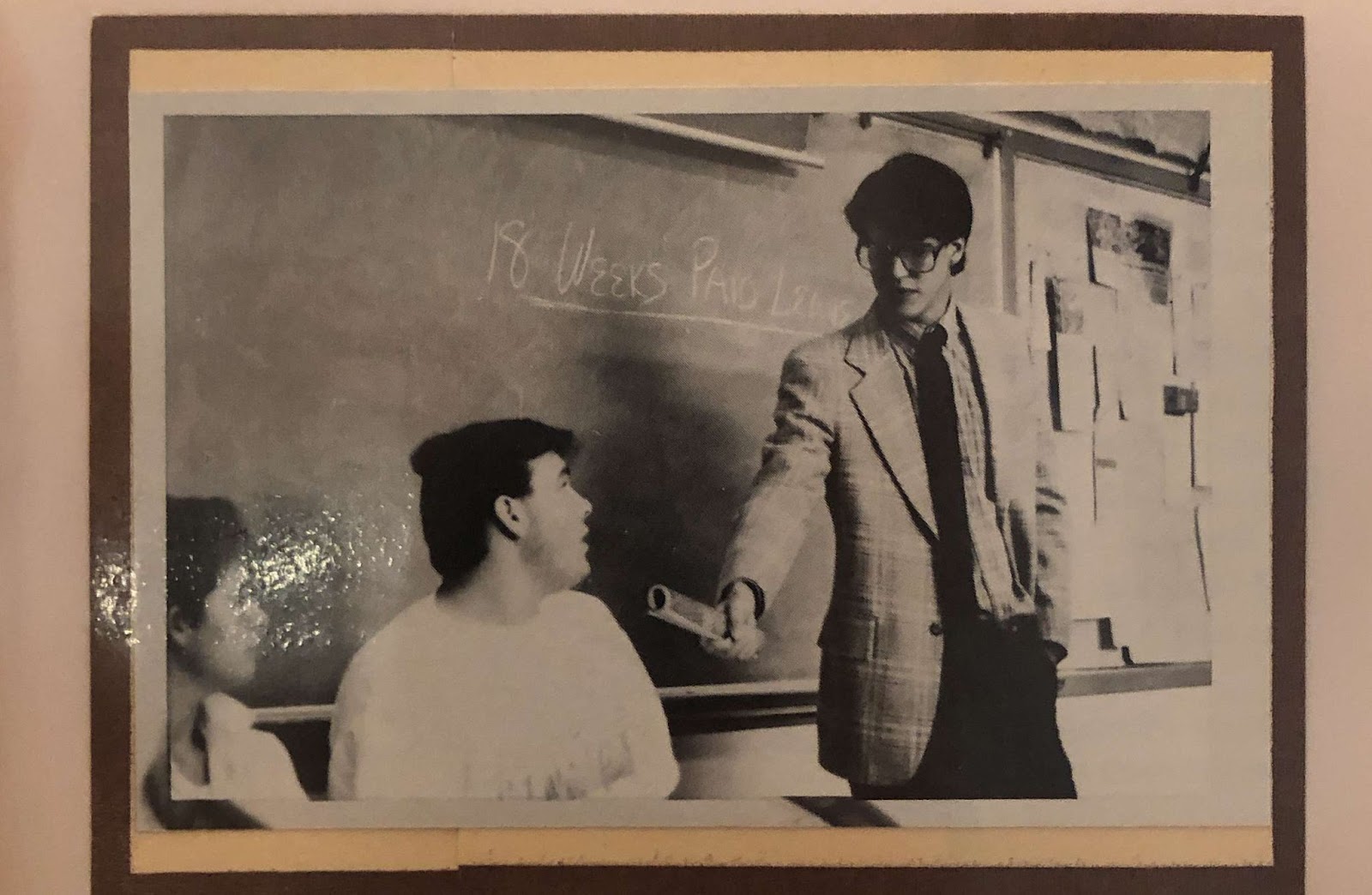
I had a fairly loud sport coat, and I bought some large framed glasses, rolled up a magazine to use like a microphone, and my low-budget transformation of Classroom B-10 into the Phil Donahue show was complete. Sometimes it was just me (aka “Phil”) leading a discussion. Sometimes I had students prepare and role play as panelists. But we always had the entire classroom participating, in the same way that Phil Donahue did. In the picture above, we were discussing an 18-week paid maternity leave for women, an idea that was being discussed in Congress at the time.
Most students loved these Phil Donahue-esque segments in my class. They had to listen to others, respectfully speak their mind (Jerry Springer didn’t come around until many years later, and I think his show would have been a poor format for the classroom), and really think about the issue being discussed.
But not all students loved Phil Donahue or my other active classroom teaching methods. I had more than a few say, “Can’t I just answer the questions at the end of the chapter?” For some students, being a sloth seems like the easy life. But it’s not the good life.
There are some people who push teachers to stick to the textbook, as it keeps any controversy from entering a classroom. Anytime I hear a politician say that teachers should stick to the textbook, I say that they don’t know enough about how to engage students. Classroom discussions, meaningful work in small groups, high-interest reading materials, considering ideas from different perspectives, and being pushed to think and write clearly and effectively – these are just a few of the ways to make classrooms more meaningful and interesting to students.
And, by the way, just because the classroom is quiet, don’t assume the students are engaged. Particularly in schools where students are focused on college admission, they will put up with some pretty boring teaching just to get a good grade. There’s a big difference between compliance and engagement, and as an educator I am far more interested in engagement.
Traditional high school history classes cater to strong memorizers. But when I went to college, I found that writing and thinking mattered WAY more than memorizing – in every class. And in life, it’s not even close. Don’t get me wrong – having the ability to recall facts is always helpful. But being able to effectively think, speak, and write blows the doors off of memorization. In four years of college, I never had one single multiple choice test. That all changed when I entered my masters in education program. Sigh.
So thank you Phil Donahue. Thanks for breaking the talk show mold. Thanks for modeling how to respect all participants, and eagerly listen to what they had to say. Thanks for delving into important, difficult, and sometimes controversial issues of the day. And thanks for making me a better and more interesting teacher, and maybe making the learning experiences of my students just a little more enjoyable.
If you’re not on the mailing list, you’re missing out. Not only will I let you know when my blog posts come out, but you will get my once-a-month-subscribers-only message. I share what I’m cooking, what I’m watching, what I’m reading, and other news that had a profound impact on me. Thanks to all who let me know you appreciated it. If you’re interested, please click here.
And something new, I am publishing this post in podcast form a few days after I post it here. The podcasts are very basic at this point. I read the post, embellishing it for better or for worse with a few thoughts that come to my weird mind as I’m reading. We’ll see how it works out. If you would like to subscribe to that podcast, please click here.
Post #115 on www.drmdmatthews.com
NOTES
Phil Donahue’s daytime show was one of the first shows to treat women as intellectuals. Wrote humorist Erma Bombeck, “He’s every wife’s replacement for the husband who doesn’t talk to her. They’ve always got Phil who will listen and take them seriously.” Funny, and sad. It reminds me of John Prine’s line in Angel from Montgomery, “How the hell can a person, Go to work in the mornin’, And come home in the evenin’, And have nothin’ to say.”
Joe Biden recently presented Phil Donahue the Presidential Medal of Freedom, saying he, “helped change hearts and minds through open and honest dialogue.”
Phil Donahue married Marlo Thomas (of That Girl fame). They met on his show, and if you watch that clip, you can kind of see their feelings for each other live on air. They were married for 44 years, and their close marriage was legendary. Just last year, when asked about what made their marriage so successful, Marlo Thomas said, “I call it the three Ls: love, listening and lust … You have to listen, and then you’ll know what the other person is really thinking and going through. You have to love each other. And without lust, you don’t have anything.” Good stuff right there.
My thanks to my senior social studies teacher, Mr. Don Lawson. He taught a National Problems course that had no textbook at all. We read interesting texts, discussed the upcoming election of 1980, examined local challenges of poverty, and he gave us the time and the freedom to write a research paper based on what we were studying. And I will say it publicly that though I thoroughly enjoyed writing that paper (Title: Poverty Profile: Little Rock) with my friend Craig, it would have been even better if I had not been infected with an acute case of senioritis. In spite of that lack of total commitment, I loved the class and the way we went into depth on real and current issues, and it certainly influenced how I taught later.
A thought about Maternity Leave. When I left my education career, I had hundreds of unused sick days. They were kind of my disability insurance, as, if I needed to be out for some kind of long illness or injury, I could have been paid for over a year while I recovered. But for female teachers who choose to have children, they have to use at least three years worth of those sick days during their maternity leave. It never seemed fair to me, as mothers had to build back their sick leave to have any kind of significant bank. Just one more thing I’d like to see changed in this world.
Phil Donahue picture from USA Today
I love the idea of the Olympics – the every-four-year gathering of the best athletes from all around the world. At its best, it is a respite from world tensions and a two-week focus on human effort and competition that creates greater understanding and appreciation of our similarities and differences. I have spectacular memories of Olympic highlights through the years: Mark Spitz’s dominance; Olga Korbut winning our hearts; the US Hockey Team miraculously defeating Russia in 1980; the flaming arrow in Madrid that lit the 1992 Olympic cauldron; Mohammed Ali, perhaps the most famous athlete the world has ever known, shaking with Parkinson’s as he lit the 1996 cauldron in Atlanta; and so many more.
Watching the Olympics was so much easier when there were just three main networks. All I had to do was switch to Channel 7 (ABC) to watch every evening, then most of the day on the weekends. NBC has carried the Olympics since 1988, and, now, I’m told that the best way to watch it is on NBC’S streaming service: Peacock. I have taken a strong moral stand against streaming services, and I drawn the line at Peacock. Take that Peacock! You’re talking to a principled man who won’t purchase every streaming service. Sure, I have a few others. Apple TV+? Of course! Two words: Ted Lasso. Netflix? Come on, you have to have Netflix! HBO/Max? How else would I have watched Game of Thrones? Hulu? Yes! The Bear needs to be watched! Disney? It’s essential. But adding Peacock? No way! I am a respected educator and blog writer, and I just don’t go out there and get every single streaming service. I hope that my discipline can inspire all of you to make tough decisions like these.
My “cable” service is YouTubeTV. It costs me about half of what DirecTV costs (which I clearly spend on other streaming services), and I love it. It records a gazillion Olympic events on NBC, and I can choose what I watch. I have loved that.
As I write this post, the 2024 Paris Olympics are well into their second week, and already there are many highlights that represent what the Olympics are all about. So here are my highlights from the 2024 Paris Olympics, so far.
- Although there have been problems and controversies, overall, Paris has shined in these Olympics. The backdrop of the Eiffel Tower is wonderful. But my biggest takeaway from our hosts is, when did the French become such good athletes? They are on the podium with the total medal count; they have the best male soccer player in the world; the NBA rookie of the year is French; swimmer Leon Marchand won two gold medals in two brutal events separated by just two hours; and so many more. So now the French are the best cooks, the best romancers, and the best athletes? What is going on?! I say, good for France! It has been fun to watch.
- Simone Biles came back. After a disappointing Olympics in Tokyo, the world’s greatest-ever gymnast stormed back and performed beautifully. Watching her perform, and seeing how, when she is at her best, she is so far superior to her competition, is something that I will always remember. And I am grateful to her for showing so many that mental health crises are real, and that they can be overcome.
- One of my favorite stories was Ni Xia Lian, the 61-year-old ping pong athlete from Luxembourg who won her first round game. Maybe there’s hope for me yet! Of course, she was a champion early in her life, and spoiler alert, I was not. My favorite quote from her: “My style is old fashioned, but my technique is advanced. You can always change what you do, always improve.” Awesome. And, sexagenerians rock!
- For the first time in twenty years, an American, Noah Lyles, won the 100-meter dash in a super close photo finish. I loved his appreciation for all the support his family has given him as he overcame so many obstacles to become the world’s fastest man. After the win, he posted, “I have Asthma, allergies, dyslexia, ADD, anxiety, and Depression. But I will tell you that what you have does not define what you can become. Why Not You!” As an educator, I am all about success stories like Noah Lyles.
- Katy Ledecky cemented her status as the greatest distance swimmer of all time, and is now among the most decorated Olympic athletes of all time. In Paris, she won both the 800 meter and 1500 meter races. The 800 was close, but she clobbered the competition in the 1500. This is her FOURTH Olympics, and she has won at least one gold medal in each. And if she wants to endure that pain and suffering of swim training for a while longer, she could probably win the 1500 meter race when the Olympics come to LA in 2028. Incredible!
And I will end with the two best memes from the Olympics:
- If you did not watch the men’s team gymnastics competition, you did not see the focus on the very last guy performing for the US team – Steve Nedoroscik, aka, “Pommel Horse Guy.” Nerdy with Clarke Kent glasses, and NBC had a timer on the screen whenever they cut to him, counting down the hours, minutes, and seconds before he performed. Most of the team members perform all or several events, but Steve was only there for pommel horse – the last event in the team competition. Twitter was going crazy with anticipation, and the team needed an awesome performance from him to earn a medal. And yes, Steve Nedoroscik took off his glasses, transformed from Clark Kent to “Pommel Horse Guy,” and came through like a champ. And here’s my favorite meme from USA gymnastics:
- The other awesome meme came from the team pistol event. The special equipment that shooters typically wear makes them look futuristic – glasses where one eye is covered and the other has colored lens, sometimes a visor, headphones to eliminate distractions, and more. Then along comes Turkey’s Yusuf Dikec, who wears, well, kind of a fall afternoon vibe – jeans and a t-shirt, and no equipment at all. Tweets and memes had him “just dropping into the Olympics,” or as a “trained assassin who was given one last job for his country,” or “as cool and casual as John Travolta and Samuel L. Jackson in Pulp Fiction. When asked about his casual style, Dikec said, “I did not need special equipment. I’m a natural shooter.” Yeah you are, Yusuf. Yes you are.
I’ll stop there, but I hope you can see how much I have enjoyed the stories and accomplishments in the Paris Olympics. The world has come together, competed, and come away a little closer. At least for a while.
If you’re not on the mailing list, you’re missing out. Not only will I let you know when my blog posts come out, but you will get my once-a-month-subscribers-only message. I share what I’m cooking, what I’m watching, what I’m reading, and other news that had a profound impact on me. Thanks to all who let me know you appreciated it. If you’re interested, please click here.
And something new, I am publishing this post in podcast form a few days after I post it here. The podcasts are very basic at this point. I read the post, embellishing it for better or for worse with a few thoughts that come to my weird mind as I’m reading. We’ll see how it works out. If you would like to subscribe to that podcast, please click here.
Post #114 on www.drmdmatthews.com
NOTES
For the second summer Olympics in a row, Russia is not present. I don’t miss them. Back in Tokyo, it was because too many of their athletes were doping, and the government was trying to sabotage the drug detection data system. This time, it’s Ukraine. Being more political than I usually am in these posts, the Russian government is a terrible force in our world, and I question the motives of anyone who would support them. I don’t miss them, and I thank the Olympic committee for banning them. And I’m still mad at them for cheating their way to a gold medal in basketball in 1972.
Over 20% of Team USA hails from California, a percentage far higher than population would indicate. A very interesting article in the LAist hypothesized that beyond the weather, one reason for such a high percentage is the fact that California has hosted several Olympics games. Perhaps because of that, it’s not too difficult for Californians, “… to find an Olympian, making the feat of becoming one seem more attainable.” And Sally Ride said it well also, “You can’t be what you can’t see.” It’s one more good reason for choosing friends who are better than you. When you hang around amazing people, you’re motivated to be a little better. I like it.
And since you asked which American universities sent the most athletes to Paris, the top three are Stanford (37), UCLA (17), and USC (16). Go Cardinal! Go ACC! Go Big 10! Why is it called the Big 10 if there are 14 teams in it? I miss you already Pac 12. Do you know how many teams there were in the Pac 12? Twelve. Maybe we focused too much on academics in the Pac 12, so we just counted up the teams and let that determine the name of the conference.
Finally, I know that this post was a rose colored glasses post. I know all about the controversies. I am saddened by controversies that are political in nature, but I know that it’s hard to do anything these days without creating at least one political firestorm. People are eager to criticize, and happy to do so loudly. Other logistical issues, like the Seine River, were pretty rough, but that one may end up creating cleaner water in the future around the world. With these Olympics, I choose to have blinders on and focus on the positive, and there is so much to celebrate.
Photo Credits: X, and Fat Tire Tours.
Who’s in that Lane for July of 2024?! Bill Marshall and Kim Kitchen, that’s who!
First of all, just a reminder that these Who’s In That Lane! pieces celebrate our Conejo Valley Multisport Masters club and our teammates, and help us to get to better know our lane-mates and the people in those lanes over there! I know we all enjoy being a part of CVMM, and it’s even better when more of us really know each other! Secondly, what happened to June and July? Two months went by without a post, and I know that the anticipation is high for this August publication of Who’s In That Lane!?!?!
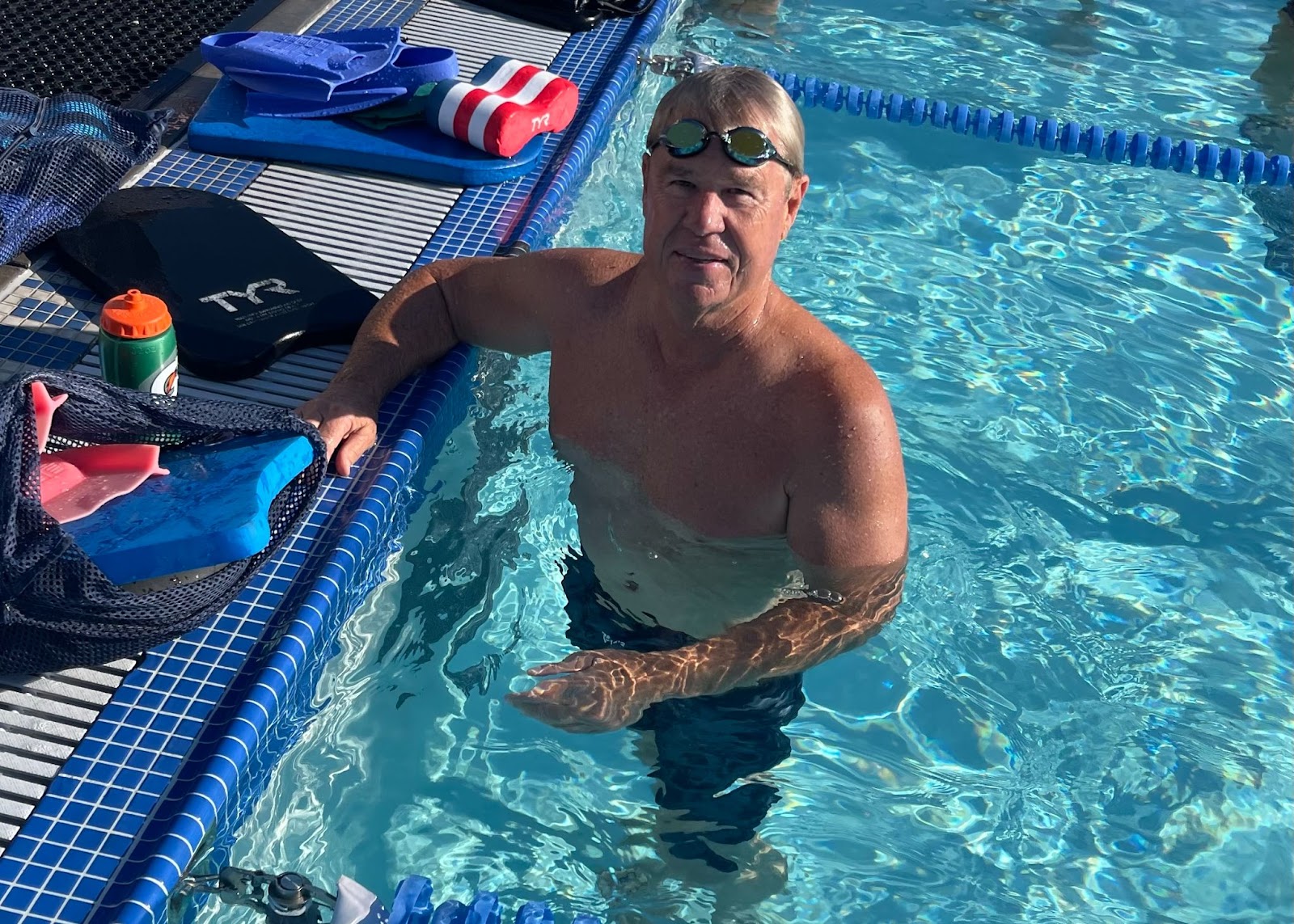
Let’s start with Bill Marshall. Bill has been a CVMM member for ten years, and he’s been back as a regular for the last three years. That’s the thing about CVMM – life happens, and if you have to take a break for any reason, CVMM will be waiting for you with open arms when you are ready. Bill loves Coach Nancy, and appreciates the way she helps him to get stronger and faster. Like all of us, he appreciates the camaraderie and the friendship that comes with being on our team. He also enjoys swimming regularly with his ex-wife Shelly, who swam with Nancy at UCLA. You see, even if marriages don’t work out, the friendships can stay strong through CVMM!
Bill swam competitively in high school and at the United States Air Force Academy. Let’s just think about that for a second. For those of you not familiar with the application process, just getting into the AFA is an amazing accomplishment, but to swim there as well? Very cool! He did a few masters meets in the 1980s, but it’s only been in the last two years that Bill started competing again. He enjoys competing in the 50 and 100 breaststroke and freestyle, as well as the IM.
Bill was an American Airlines pilot for 35 years after his military career. These days, as a retired colonel from the US Air Force, he is one of the USAF representatives who travels around the country supporting students and families who are applying for a coveted admissions slot in Colorado Springs. As a former high school principal, I can tell you that when the military representatives present that 4-year scholarship to students, currently valued at over $400,000, it is a giant moment for the student and the school. And without exception, it is the best of the best who earn those scholarships.
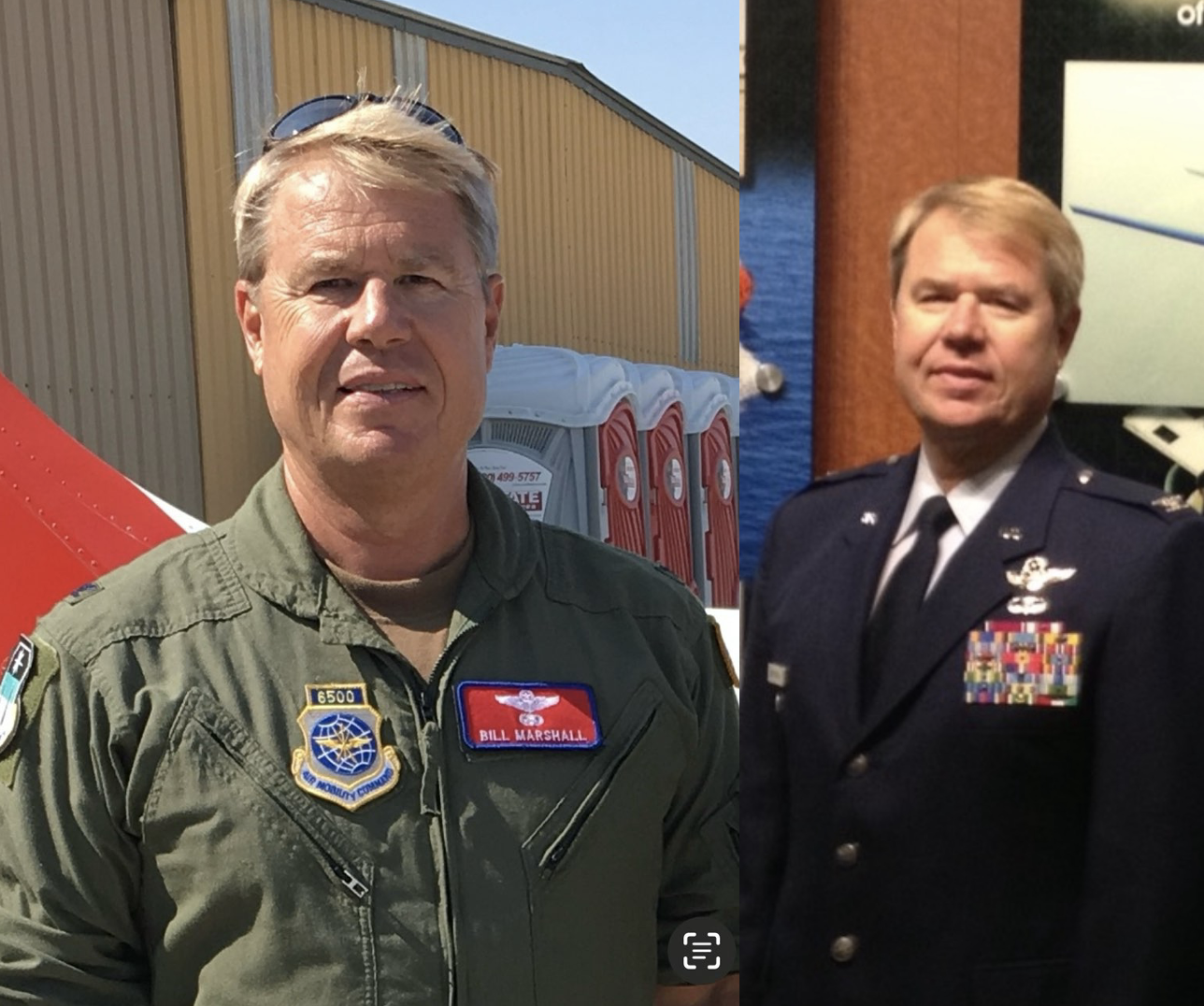
Outside of the pool these days, you’ll find Bill helping others by volunteering to help people fill out tax forms, and by substitute teaching.
As for our workouts, you find Bill usually swimming in the evenings and on Saturdays, and occasionally at noon. His favorite part of the workout is the rest between the swims, even if it’s just ten seconds. Hilarious! (And we all know what you mean!) He would rather not do the long swims, and if pushed, he can do 5 x 100 yards on the 1:30.
So thank you for your service to our nation, our schools, and to those in need, Bill Marshall, and thank you for being part of our CVMM family!
And now, Kim Kitchen is in that lane!
Kim is relatively new to our team. She’s been part of CVMM for one year, and already, she loves the team feel and camaraderie. She appreciates the coached workouts, and knows they make her better. Kim has never been part of a swim team before this, and has never swam competitively. That being said, she is doing some very cool things with her conditioning.
Like many on our team, Kim is a triathlete. She is a two-time ironman finisher. Kudos to Kim and all of our teammates who have heard, “You are an Ironman,” as they cross the finish line. I love the triathletes on our team. Some of them have always been strong swimmers, and some are really just trying to be stronger on the first leg of the triathlon. They are a family within a family, and Nancy knows how to help them to be their best.
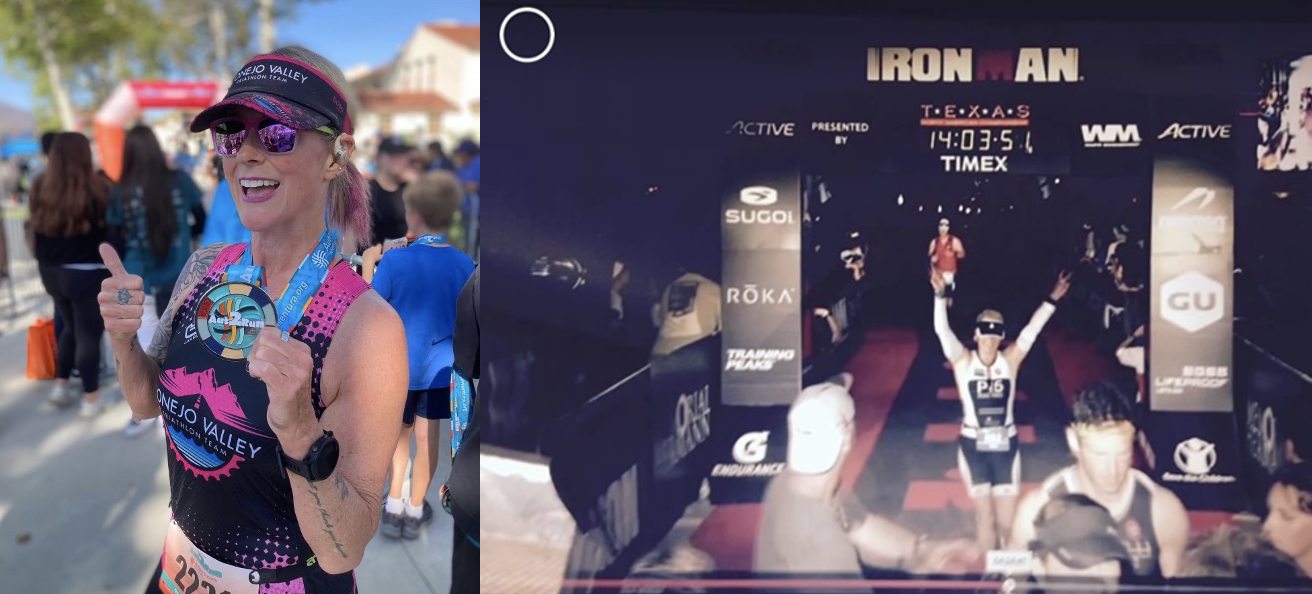
Unlike many on our team, Kim is also a competitive prone paddleboarder. She says that swimming definitely helps with paddling and vice versa. Listening to Kim makes me want to paddleboard, she says, “I love the freeing feeling of paddling out in the water! I love that I can cover so many miles with just my hands! It’s so beautiful out there! It’s my happy place! It’s such a great feeling to be gliding along the water!” Kim recently qualified for the 32-mile race from Twin Harbors on Catalina to Manhattan Beach, and is excited to see what she can do in that famous and historic event. Wow! Keep us posted!
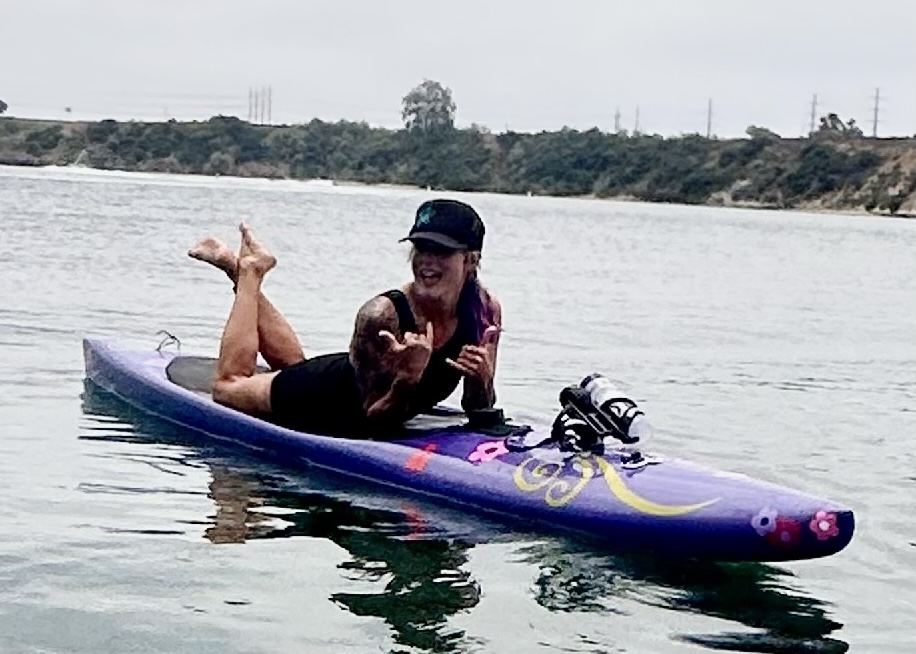
Kim is a mother of two teenages, an elementary school Special Education teacher, and a reading tutor. She has been teaching for 25 years! In other words, she’s a hero by day (I have a bias and I am a huge fan of anyone supporting student learning), and an incredible athlete on the side. I love it.
So thanks to our CVMM lanemates Kim and to Bill for letting us all learn more about them. Say hello to them no matter what lane you’re in!
To see previous Who’s In That Lane pieces, please click here.
Thanks for all of the emails and comments on Part I of my Year One Retirement Progress Report. My Dad wrote that he liked it, but it was way too long and could have used several more drafts. He’s not wrong. So I’ll shorten my introduction by five paragraphs (Winning!!) and get right to examining the last three criteria: Sharpening the Saw, Relationships, and Purpose.
Sharpening the Saw
In Steven Covey’s introduction to his 7th Habit of Highly Effective People, he famously asked, “Have you ever been too busy driving to stop for gas?” He also quotes Abe Lincoln’s, “Give me six hours to chop down a tree and I will spend the first four sharpening the axe.” Like Abe’s axe, our lives will become dull and ineffective if we do not make the effort to improve ourselves by seeking new knowledge and new ways of thinking, and by taking time to deliberately reflect on what we are doing well, and what needs to be improved.
Covey pushes people to sharpen their saw constantly in order to be the best they can be. He targeted mostly working people, but I know he would say it’s critical for retirees too. My friend John died this year at age 95. When I visited him last, he was on a reading tear, learning all he could about ancient east African civilizations. Why is it that those whose axes are the sharpest are the same ones who spend the most time at the sharpening stone? President Obama publishes the extensive list of the books he has read and music he is listening to at the end of each year. It is stunning how much he can get done. Theodore Roosevelt read a book every day while he was president. Though I can’t hold a candle to the people above, here is what I am doing to sharpen the saw in my retirement.
- I continue to be an avid reader, though I have added the lens of reading as a means of learning how to write better. I keep a journal of writing lines or passages that hit home for me, and hope that it can inspire me to add beauty and depth to my writing. Seeing and reflecting on those passages is in itself a beautiful moment, like watching a blue heron fly silently by while you are sitting next to a river having a cup of coffee and finalizing your blog post.
- I look for, and sometimes pay for, good coaching. I have appreciated and written often about my masters swim coach, and my golf game is less atrocious due to professional coaching. Sometimes, coaching comes from cookbooks, or from videos on cooking or pickleball, and there are certainly plenty of coaches from whom we can learn more about living well. There is so much expertise in the world, and to not use it is truly a missed opportunity.
- Finally, and this is easier in retirement, I try to take as many opportunities to pause and reflect as I can. Consuming a large quantity of books, podcasts, or lectures doesn’t mean much unless we take the time to ponder how they might impact and improve our lives. My calendar has many more open spots in it than before, which means I’m not rushing like I used to from meeting to meeting to meeting to meeting to meeting. Looking back at my career, I wish I would have been better at leaving open spaces in my calendar, so I could have paused more to reflect and plan. Too often, I was too busy driving to stop for gas. But now, I have the luxury of time, and I am working to be better at pausing, reflecting, and sharpening the saw. I appreciate the research on reflection in the Harvard Business Review, which stated, “The practice (of reflection) itself is all about learning, looking back on the day (without bias or regret) to contemplate your behavior and its consequences. It requires sitting with yourself, taking an honest moment to think about what transpired, what worked, what didn’t, what can be done, and what can’t. Reflection requires courage. It’s thoughtful and deliberate. Being at the ‘top of your game’ only comes when you extract from the past how to engage the future.”
As for the progress report . . . After one year, Teacher Mike would tell me that I am growing, and I am spending time sharpening my saw, but that blade could be a lot sharper. I need to be more disciplined and make the time for both learning new information and finding time to reflect, and make more deliberate efforts to be more like Abe the axe-sharpener.
Relationships
One of the things that I miss the most in retirement is the social interactions that I enjoyed at work every day. I miss the short little conversations, the checking in on each other, the inside jokes, hearing about roses and thorns, and the hundreds of light and deep conversations I had over the course of a week. Most of those work relationships will fade away. This means that everyone who retires has to maintain their existing away-from-work relationships, and, in the best of all possible worlds, develop new ones. There is data from the Blue Zones research that confirms that healthy relationships improves and prolongs human lives.
Speaking of my marriage relationship, perhaps my biggest win after one year of retirement is that Jill doesn’t hate me. Victory! Jill works at home a few days a week, therefore we see each other more than we ever have. And after a year, not only does she not hate me, but we both agree that we are thriving with our new time together.
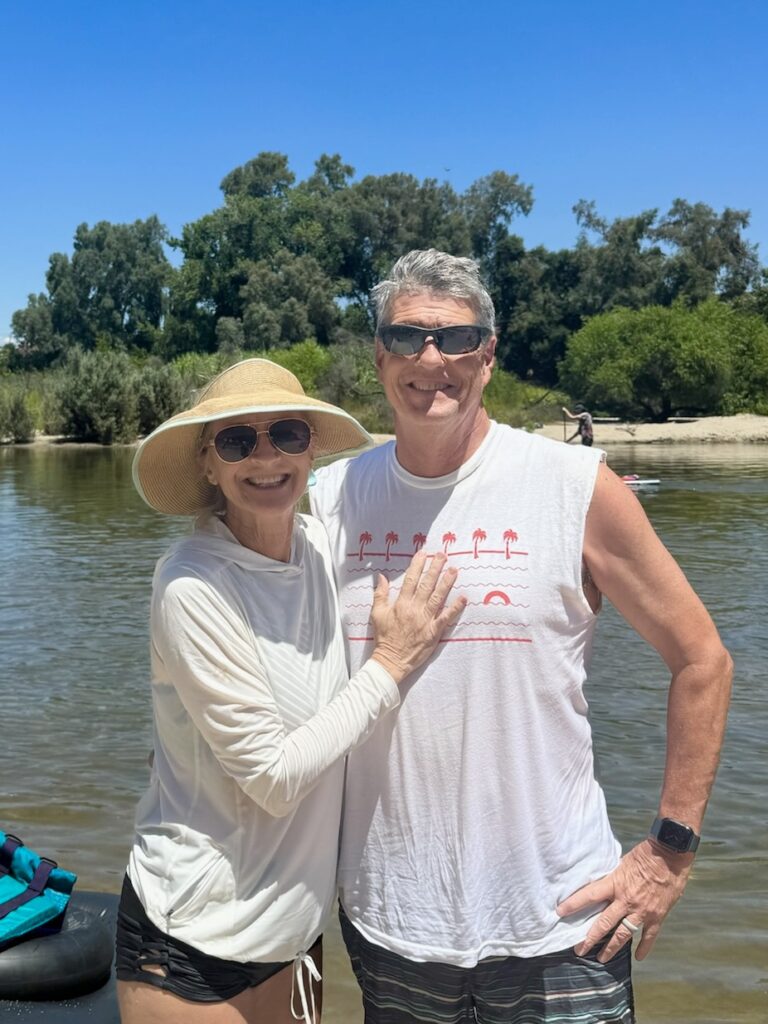
I am also free to travel more to see my family. I’ve taken several trips to Arkansas and Sacramento, and I will be going to southern Washington in August for my nephew’s wedding. Many of these trips would have been impossible to take while working, and they all serve to make my family relationships deeper.
And I will continue to enjoy life with friends. One of my favorite things to do is organize big and little experiences and adventures with my friends. It could be a bike trip, a fantasy football league, pickleball Saturdays, a bbq, or any number of things. My friend Grant (a regular blog reader!) is one of the best at this, and he shared, “When you help a group of people to have a good time, or to do something fun together, and they leave with a smile, I think that makes us live longer.” I think you’re exactly right, Grant.
On the virtual side, these blog posts have been a wonderful way to keep in touch with friends. I hear from my high school classmates, former students, parents, and colleagues from my jobs all over California, and even a few new people that I’ve met through my writing. With an average of around 300 readers, I am still able to respond to everyone who comments or emails. Thanks to all of you who make that work so well.
As for the progress report . . . After one year, Teacher Mike would tell me that I am doing OK here, but I cannot rest. Relationships take initiative, care, and a lot of work. They are too important to take for granted.
Purpose
Why do you wake up in the morning? If you like your answer for that question, then you have a sense of purpose. Blue Zones research points to healthy relationships adding seven or more years to your life. I was fortunate to have a career that gave me so many ways to answer that question for almost forty years. And now, I need a different answer.
One of the most difficult parts of retiring after 39 years in the same field is that I left at a time when I was at the height of my knowledge of not only what works in public education, but also how to best support leaders and educators in the important work that they do. I don’t know how much longer I can do it, but I am enjoying using that knowledge and experience to support districts and leaders as an educational consultant. Some of that work I get paid for, but most of it I do just to support former colleagues. I am enjoying my work as a consultant and mentor, supporting leaders, helping teams be their best, and supporting districts with challenging tasks, and it is one of the things that answers the question of why I get up in the morning.
I will be a proud educator for all of my days, and I will continue to use that passion and knowledge, even after my consulting days are done. Still, I need to look beyond my former career-related endeavors for my sense of purpose. So what else is there?
What makes this transition easier for me is that I have never derived my entire identity and sense of worth from my career. I have always had other interests. I think a lot of it goes back to the other criteria is this progress report. Sharpening the saw can be a purpose-creating activity in itself. Healthy, loving, and enjoyable relationships can give more than enough purpose to make a life worth living. Finding ways to give back and make the world a better place for others adds to a sense of purpose. And finally, the pursuit of spiritual growth cannot be ignored. We all have to find our way.
Teacher Mike, in his assessment of my pathway to purpose, would agree that I am one of the lucky ones. He would also agree that consulting will not last forever, and I will have to rely on purpose-giving activities that have nothing to do with my career. The search for purpose is not a static one. One of my sayings is, “Today is a good day.” I have said it for the last twenty years, because you never know what challenges today, tomorrow, or next week will bring. Appreciating and embracing each day lets me wake up each morning with so much to look forward to. And when those next challenges come, and they will, I’ll do my best to accept the challenge and continue to appreciate all of the love and beauty in the world.
So that’s my progress report. Thanks for reading this far. I hope this post has you thinking about (1) Health and Fitness, (2) Hobbies, (3) Sharpening the Saw, (4) Relationships, and (5) Purpose. For those of you who are retired, I wish you luck in enjoying this new phase of life and making the most of it. For those of you who aren’t there yet, I hope this post gives you ways to look at leading your best life now and in the future.
Thanks for reading!
If you’re not on the mailing list, you’re missing out. Not only will I let you know when my blog posts come out, but you will get my once-a-month-subscribers-only message. I share what I’m cooking, what I’m watching, what I’m reading, and other news that had a profound impact on me. Thanks to all who let me know you appreciated it. If you’re interested, please click here.
And something new, I am publishing this post in podcast form a day or two after I post it here. The podcasts are very basic at this point. I read the post, embellishing it for better or for worse with a few thoughts that come to my weird mind as I’m reading. We’ll see how it works out. If you would like to subscribe to that podcast, please click here.
Post #113 on www.drmdmatthews.com
NOTES
Harvard Business Review Article by James R. Bailey and Scheherazade Rehman. What a great article. A couple of thoughts from this study;
- The work that it took to compile thoughts of hundreds of executives was stunning. It required coding the comments, and doing a detailed analysis of that coding. It’s something that AI can now do in five seconds. We live in a different world.
- I love the recommendations for incorporating reflection into our lives:
- Keep a journal
- Set aside an hour a week to review your journal.
- Don’t just re-read what you wrote, add to it and enhance it.
—
One of my theories for staving off dementia, and it’s based on a good amount of reading on the topic, is that we reduce our chances for dementia-related illnesses when our lives are strong in these three areas;
- Exercise, particularly when it’s outside. Walking, hiking, biking, golf, you name it. Get off your ass and do something that gets your heartbeat up.
- Social engagement. Loneliness is an epidemic in this country, and maybe beyond. Be a part of a church or other organization. Get out of the house and be with friends and family. Don’t let the TV be your most frequently visited companion.
- Keep your brain active. Solve problems. Learn something new. Brush your teeth with your non-dominant hand. Always look to be growing as a person.
I know people who do all these things, and still get dementia. But science says we do better, and more than anything, life is a lot more enjoyable because we are doing those things.
—
Maybe I don’t want my saw to be too sharp. Funny story, or so I think. While with the fantastic Manhattan Beach Rotary Club, I volunteered to be a sous chef for a fund-raising dinner by a celebrity chef. In this case the celebrity was a 7th grade Manhattan Beach student who had just won a Chopped, Junior competition. How hard could that be? I arrived at the beautiful home where we were preparing and eventually serving. The 7th grader asked me if I brought my own knives. Um . . . no. Then she asked if I had ever used sharp knives. The nerve of the kid! Give me that knife! But just to check, I did lightly touch the knife with my fingertip. Mistake. We’ve got a bleeder! Five minutes on the job, and I almost ruined everything. So, the saw that we sharpen doesn’t need to be razor sharp. I don’t know if that story works, but I sure like it!
—
I love the Blue Zones research. Here are all of the references to it on my website. And here is the Blue Zone website that is so worth your time.
—
This post was still too long. Sorry, Dad.
—
I mentioned my “Today is a good day” refrain. A more famous version of that comes from my former colleague Sandy Casey. Here is what I wrote in my post on Sean: While I was Superintendent in Manhattan Beach, one of our most beloved teachers at Manhattan Beach Middle School was one of the people tragically killed at the Route 91 Music Festival in Las Vegas. Her name was Sandy Casey, and she taught some of our most impacted students. She had a saying: “Today is a good day for a good day.” In the wake of our loss, we remembered those words, and if you look around, you can see that saying written in cursive on doors throughout the school district. Sandy continues to teach us to find ways to make the most of each day. I love it. ”
—
The pictures in the post are from a vacation with friends camping by the Kings River near Fresno, CA, where we spent our 100-degree days floating down the river on tubes, cooling off in the 55-degree water, playing a gazillion games, laughing, and making lots of memories. Please don’t give me too much of a hard time for having my computer at the river. These blog posts don’t write themselves!
Click Here for Podcast Version
I’m not a big fan of report cards. They are so . . . final. A progress report is much more helpful – it’s a check in on how it’s going, and guidance on how to be more successful. As a teacher, one of my favorite projects was the five to ten page research paper, where the first draft was due two or three weeks before the final draft was due. I would spend hours commenting on those drafts. There was no grade. There were only recommendations for what needed to be changed, improved, deleted, or added. Then there was the conversation about my recommendations. It was not long, five to ten minutes, but when it worked, the student left with a clear vision of what needed to be improved. In some cases, where the quality was lacking, I recommended a second or even third draft that I could review. The whole project was a process. If students did what I asked, it was hard not to earn an A or a B on the final grade.
I’m taking a similar attitude as I reflect on finishing my first official year of retirement. I’m not giving myself grades, but I am going to take the time to reflect on how it’s going, what I’m doing well, and what I need to work on. Sounds kind of funny, doesn’t it? Working on retirement? But I don’t think that living your best life in retirement is one bit easy. And, spoiler alert, there are many things I could be doing a lot better. I’ve written this before, but many of my posts are intended to give me the kick in the a** I need to make the most of however many more days I have left on our crazy and beautiful planet. This one certainly fits that mold.
One thing I did right was taking a practice run. Back in August of 2021, I stopped working for about eight months. My main reasons were that I had been in the same job, the same GREAT job, for eleven years, and it felt like time for a change. But I’d be lying if I didn’t say that COVID was soul-crushing for most educational leaders. Dealing with all of the regulations, the fears of parents and employees, and the anger of too many people, all mixed in with incredible uncertainty, left many of us exhausted, less healthy than ever (my blood pressure was high for the first time in my life), and beaten down. So I took eight months and did nothing. No commute, no consulting, no nothing. I played golf twice a week, went to museums with retired friends, cooked more, and wrote more. What I learned was that I liked it just fine. And by “just fine,” I mean that it was wonderful.
Our financial advisor told me that we could afford to have me retire, but she also said, rather directly, “BUT IT WOULDN’T HURT YOU AT ALL TO WORK ONE MORE YEAR.” That led to me taking the superintendent job in Placentia – Yorba Linda, and having one of the most enjoyable work experiences of my life. I was inspired by the kindness and high quality efforts of almost everyone I met. I officially retired at the end of that year, with my first day of retirement being July 1, 2023.
So in terms of my preparation for retirement, that practice run was super helpful. If you can manage it, I highly advise it.
And now, one year in, I have zero regrets about retiring. My only focus on this progress report is not on whether I should have retired, but how I am doing in making the most of it. Although I do not have a retirement progress report form (yet!), I will be organizing this by analyzing via a few categories. I may change them over time, but for now, I’m going to look at how I’m doing in the areas of (1) Health and Fitness, (2) Enjoying my Hobbies, (3) Sharpening the Saw (Steven Covey’s term for always working to improve yourself), (4) Relationships, and (5) Purpose.
Section 1: Health and Fitness:
I’ve written a lot about health and fitness in my blog posts. It’s important to me, and it’s important if I’m going to enjoy a long retirement. Here are some quotes I’ve been writing about and apply to this part of the progress report:
- From Michael Easter’s, The Comfort Crisis:
- “Most people today rarely step outside their comfort zones. We are living progressively sheltered, sterile, temperature-controlled, overfed, underchallenged, safety-netted lives. And it’s limiting the degree to which we experience our ‘one wild and precious life,’ as poet Mary Oliver put it.”
- “A radical new body of evidence shows that people are at their best—physically harder, mentally tougher, and spiritually sounder—after experiencing the same discomforts our early ancestors were exposed to every day. Scientists are finding that certain discomforts protect us from physical and psychological problems like obesity, heart disease, cancers, diabetes, depression, and anxiety, and even more fundamental issues like feeling a lack of meaning and purpose.
- “Are you not important enough to do it for you?”
- From Chris Crowley and Henry Lodge’s Younger Next Year:
- “Exercise hard six days a week,”
- “Aerobic exercise does more to stop actual death, but strength training can make your life worthwhile.”
- And the general message from the Noom diet, the Mediterranean Diet, and a gazillion other reasonable diets:
- Lots of fruits and vegetables, plenty of lean proteins, some healthy carbs, and as little sugar and processed foods as possible
I would not call myself a good sleeper yet, but I’m better than I was while I was working. I still get up super early at least twice a week to swim in my masters workout that starts at 5:55 AM. And between pickleball, my Peloton, and swimming, I exercise hard four to six days a week. That’s pretty good, but the reality is that it’s not different from what I was doing when I worked 60 hours a week. Almost every retired person I talk with says something like, “My days are so full. I can’t believe I did so much when I was working.” I have so much more time now, yet it’s still challenging to get things done. I thought I would significantly up my health and fitness game in retirement, but so far, that’s not the case. I am debating whether I can be healthier without a more rigid schedule, or without some kind of commitment to make my life a little less comfortable.
In terms of diet, I wrote about being on the Noom diet two years ago. It was highly effective. Turns out eating fewer calories and eating healthier foods is good for you. Who knew!!!! I stopped recording all of my food intake, just because it’s kind of a crazy, obsessive lifestyle that I did not want to continue. The result? I’ve gained back some of that Noom weight loss, and I don’t love it. Again, I am questioning whether I should reduce my looking at retirement as a comfortable lifestyle, and whether I should be mixing in more discomfort so that I can fully enjoy retirement life for the long term.
Finally, in terms of health and fitness, my left knee is not cooperating. I have a full replacement scheduled for early December, and I’m looking forward to it. Kind of. If I wanted to delay the replacement, I would stop playing golf and pickleball. My friend and awesome-across-the-street-neighbor Jack saw me limping back after playing two hours of pickleball, and said, “Don’t you have a doctorate degree?” Yes, Jack, I do. And yes, a more intelligent person would avoid this bone on bone knee pain by not playing golf or pickleball. But I love both of them, and that’s not the lifestyle I want to lead. I am hoping that getting that surgery will give me twenty years of fully enjoying not just golf and pickleball, but also plain old walking. My knee pain is a discomfort I would like to live without. I have a plan!
So in terms of overall health and fitness, I have some work to do. My teacher feedback after this one year first draft effort might be, “You know what you have to do. Just do it.” Easily said, Teacher Mike. Also – that’s not very helpful. I would hope that progress report conversation would congratulate me on sleeping better. I’ve been a crappy sleeper for a long time, and every bit of research says that’s detrimental. We would then move into what I could do to push myself and be less comfortable, at least some of the time. Maybe it’s creating a more rigid schedule. Maybe it’s a different mindset. And maybe I’m making too much of the whole thing. As I write that, I can hear my sister Martha saying sweetly, yet sternly, “Mike, just calm the hell down and relax. You’re doing just fine.” Thanks, Martha.
Section 2: Enjoying My Hobbies
I’ve always loved pursuing hobbies outside of work. In fact, it’s one of the questions I would ask colleagues when they started thinking about retirement. I would ask, “Outside of work, what do you love doing?” Sometimes, I would get a blank stare. Other times, the answer kept going and going. I heard so many answers: grandchildren, gardening, music, sports, reading, cooking, artistic endeavors, and many, many more. For those colleagues who gave me the blank stare, I worried about their retirement. For people who define themselves mostly by their positions in their work, I worried about how they could be happy and healthy in their retirement. I will look at these same questions on a deeper level when I get into the Purpose section, but what is it that makes you interesting to yourself? What are the things you enjoy doing that make you want to get up in the morning and seize the day?
My hobbies are familiar to those who read my posts: writing, cooking, golf, pickleball, music, organizing/tidying up, travel, and swimming. The hobby I’ve added is gardening. I am enjoying taking care of about ten potted plants in our yard that add color and flavor (my basil plants are THRIVING!) to our lives. I make a big deal of the fact that I am a member of Armstrong’s Garden Center, though I admit there was not a stringent vetting process. I simply gave them my name and email address – kind of similar to my application to become a minister in the Universal Life Church. I’ve been telling Jill that my membership should earn me a little more respect around the house. So far, she’s not impressed by the membership, but she does appreciate the efforts to add color and flavor.
After one year of retirement, I continue to enjoy all of these hobbies, old and new. Going to Japan in what would have been the middle of the school year, going to spring training Dodger baseball in Arizona, and taking four trips to visit family in Little Rock were all a step up in my travel game. And my Dad says that my writing continues to improve, and believe me, he would tell me if it weren’t. I don’t know that I’m improving, but I’m enjoying the heck out of all of my hobbies. The only hobby/passion I’m not pursuing as much as I would like is my music. My guitar sits in the corner of our living room, calling out to me. I need to answer the call more.
In our progress report conference, I would hope that teacher Mike would ask what the point of these hobbies is. Is it to get better in all of them? Is it to dominate in golf and pickleball and win awards as a writer and chef? Or is it just to spend time enjoyably with friends, and to experience flow doing the things I love? Even writing this down gives me the slap in the face I need to think correctly. I can hear my sister’s voice again here. And maybe the conversation would close with teacher Mike asking me what in the world is stopping you from picking up that guitar a few times a week?
Paraphrasing Diondre Cole from Saturday Night Live, we are out of time! A full blog post, and only two of the five progress report criteria have been covered! You know what that means. This is now Part One of a Two-Part series. I will hit (3) Sharpening the Saw, (4) Relationships, and (5) Purpose in my next post. For those of you enjoying this topic, what great news! For those of you bored beyond belief, first of all, thanks for getting this far, and I secondly, apologize in advance for the next post!
Looking forward to your comments, and thanks for reading.
If you’re not on the mailing list, you’re missing out. Not only will I let you know when my blog posts come out, but you will get my once-a-month-subscribers-only message. I share what I’m cooking, what I’m watching, what I’m reading, and other news that had a profound impact on me. Thanks to all who let me know you appreciated it. If you’re interested, please click here.
And something new, I am publishing this post in podcast form a day or two after I post it here. The podcasts are very basic at this point. I read the post, embellishing it for better or for worse with a few thoughts that come to my weird mind as I’m reading. We’ll see how it works out. If you would like to subscribe to that podcast, please click here.
Post #112 on www.drmdmatthews.com
NOTES
Great quotes on being ready to retire from Fritz Gilbert’s Keys to a Successful Retirement: Staying Happy, Active, and Productive in your Retired Years. (Buy it on Amazon here)
- “If you are what you do, who are you when you don’t?”
- Richard J. Leider and Alan M. Webber (from Life Reimagined: Discovering Your New Life Possibilities)
- If you look up the definition of “retire,” you’ll find “to withdraw from action or danger.” I prefer to think of it as “re-tire,” an act in which we put new tires on our vehicles for the changing road conditions ahead.
When Jill was reading the post, and she was about halfway done, she was worried that she had already been reading for a long time, and she was only on criteria one of five. She said she was beginning to despair that it would never end. And while she was relieved when she finally learned this was part one of two, she said it might have been helpful to know that earlier. What’s the fun in that, Jill? The way I did it, you were at the edge of despair, just like the hero in a good rom-com, then all of the sudden, a glimmer of hope changed everything!
I like the teacher/progress report idea, and I have experience with it, so that analogy makes some sense to me. But I also like the idea of having a life caddie walking around with us and helping us make our decisions – both big and small. Thinking about what to eat? Ask your caddie. Need a push to add discomfort to your workout? Your caddie is there for you. Seinfeld’s Cosmo Kramer had a life caddie – and it helped him tremendously – at least for a while. Short clip here.
And if you have not had the pleasure of watching “What Up With That” on Saturday Night Live, and if you’re sense of humor is as warped as mine is, I highly recommend it. Longtime SNL star Kenan Thompson plays talk show host Diondre Cole. In each and every episode, Diondre brings in three stars, but somehow, time slips away before he can get to the in depth interviews he hopes for. You can see some of the early episodes here, and if you want, there’s more. You may think it gets less funny as the same joke gets played out in every episode, or . . . like me, you may think it gets more and more hilarious.
Growing up, July 4th was always a big holiday in our house. We did not call it Independence Day. Just July 4th. The main focus for my siblings and me was getting to the amazing fireworks stands that magically popped up in June. The red, white, and blue banners lured us in, but it was the wondrous and colorful array of explosive devices that drove us out of our minds. We were on our best behavior, just waiting for the day when our parents would take us.
What made it even better, and yet a little worse, was Dad offering to give us more money to spend at the fireworks stand. Big money! Like $20! Sounds great, right? All we had to do was write an essay on what Independence Day meant to us, and then we had to read the essay to Mom and Dad. We had all saved a little bit of money from our allowance, but $20 was too good to turn down. So we all wrote the essays.
I wish I still had those essays. They must have been absolutely horrible. Combine a child’s writing ability, completely insufficient research, and a mind way more focused on holding explosives than on the ideals of democracy, and there’s no way any of us turned in a deep or thoughtful essay. But Dad showed pity on his unfocused children, and we each earned the $20.

When the day of the fireworks stand visit finally came, we all piled into our Ford Country Squire station wagon with its yellow paint and fake wood panels. We would pull up to the dusty parking lot next to the roadside stand and start running before the car even came to a full stop. There were no pesky seat belts back then, or at least nobody wore them, so it was an easy exit from the slowing car. We would wait in line, then get to the counter to make our choices. Firecrackers, bottle rockets – we bought those by the gross – more on that later – snakes, sparklers, Roman candles, fountains, whistling chasers, and then some not-as-spectacular-as-we-would-hope aerial fireworks to end the evening. Leaving the stand with boxes and bags of fireworks felt better than Christmas. Let’s be honest, Christmas gifts are great, but you can’t blow them up!
We waited until July 4th to light most of the fireworks, but the bottle rocket wars with our cousins began the very next day. Armed with hundreds of bottle rockets, two teams of boys took refuge behind walls or piles of rocks on either side of the vacant lot next to our house, and we would proceed to fire rockets at each other for hours. You learned to light a bottle rocket, then toss it at just the right moment so it would fly screaming towards your enemies. Bottle rockets were exploding all around us, and it was glorious. We were of course wearing protective goggles, ear plugs, and fireproof clothing . . . Who am I kidding? We had no protection at all other than our shorts and t-shirts. I can’t tell you how many times a bottle rocket would hit my chest and explode, blowing a hole in my shirt and leaving a mark – some might call it a burn, but it was really just a badge of courage.
What were my parents doing while this chaos ensued? Dad was working, and Mom was inside with my Aunt Alix drinking Chablis, probably wincing repeatedly, like Chief Inspector Dreyfus in the Pink Panther movies, at all of the cracks and bangs of the bottle rockets, and wondering what they had done wrong to raise a bunch of idiots like us. Could something have gone terribly wrong? Sure! I could point to this and many other stunts from my childhood that make me marvel at the fact that I’m still here. But memories of those days do make me smile. We thought we were the luckiest and most bad-ass kids in the world.
Buying fireworks and battling with them. That’s the true meaning of July 4th.
OK. No it’s not. But that’s the 62-year-old me talking. The 12-year-old me would be rolling my eyes at hearing the 62-year-old me saying no. But no, 12-year-old me, it’s not.
Here are my current thoughts on what Independence Day for the United States of America means, using the Declaration and the Bill of Rights as the foundation. It is not at all exhaustive, but these are some of the concepts I will be celebrating. I’m not sure it is worth $20, but here you go.
- We hold these truths to be self-evident, that all men are created equal. What a radical statement that was back in 1776. It is the cornerstone of what makes the USA unique and so special. It was an aspirational goal then. I don’t think those who signed the Declaration of Independence even fathomed the true meaning of this statement, or how aspirational it would remain over two centuries later. But we have come so far. I am grateful for the American heroes who have devoted their lives toward making the progress we’ve made, and to those who continue to pursue this work. This statement will be true when statistics can no longer predict the educational, economic, or other successes of American citizens based on their race or gender. This July 4, I’ll be celebrating our aspirations, our progress, and our continued commitment to making that wonderful statement a reality.
- We hold these truths to be self-evident, … that they are endowed by their Creator with certain unalienable Rights, that among these are Life, Liberty and the pursuit of Happiness. After the American Revolutionary War, or the “American War for Independence” as they call it in the UK, Marquis de Lafayette, the French military hero who did so much to help us win that war, said, “Humanity has won its battle. Liberty now has a country.” For all of our flaws, we are still that country.
- And I’ll be celebrating the First Amendment, which put into law some of the ideals stated in the Declaration of Independence. I don’t know of a single statement that has guaranteed individual liberties more than this one. It allows us to worship as we please. It protects us from a government endorsing or establishing any religion. (Earlier this week, Louisiana voted to test that freedom, with a law requiring the Ten Commandments to be posted in every classroom – and now Oklahoma’s State Superintendent is trying to outdo The Pelican State, ordering schools to begin incorporating the the Ten Commandments and the Bible into lessons in grades 5 through 12.) The First Amendment also allows us the freedom of speech. It guarantees our right to peaceably assemble. These freedoms make us the envy of the world. And none of them is easy. You’d think after 230 years we would have it figured out, but we humans are very complex, and we keep confronting our fundamental principles with new challenges. But the struggle is worth our time and frustration.
- Mostly, I will be celebrating our nation and all that it stands for. We will proudly display our flag in our front yard. I will take a moment to be grateful for all that the benefits this country has afforded myself and others. I will take a moment to remember those who have defended our nation through the years. When Warren Buffet was asked the reason for his success, he said one of the most important elements was the fact that he was born in the United States of America. We are an imperfect nation filled with imperfect people. But we are a nation that has continued to improve its ability to deliver on its promises of liberty and equality, and that alone is a cause worthy of glorious fireworks.
Happy July 4th, and Happy Independence Day, everyone. Let’s be grateful, let’s continue our quest to make our aspirations a reality, and for those of you buying fireworks, let’s be safe out there.
If you’re not on the mailing list, you’re missing out. Not only will I let you know when my blog posts come out, but you will get my once-a-month-subscribers-only message. I share what I’m cooking, what I’m watching, what I’m reading, and other news that had a profound impact on me. Thanks to all who let me know you appreciated it. If you’re interested, please click here.
And something new, I am publishing this post in podcast form the day after I post it here. The podcasts are very basic at this point. I read the post, embellishing it for better or for worse with a few thoughts that come to my weird mind as I’m reading. We’ll see how it works out. If you would like to subscribe to that podcast, please click here.
Post #111 on www.drmdmatthews.com
NOTES
Warren Buffett goes much further than his success stemming from being born in the United States. He says that he won the “ovarian lottery,” and being born in the United States, male, and white all made his path to success easier. If he had been born to wealthy parents, that would have further increased his odds of success. It still takes hard work to succeed, and history is increasingly filled with amazing success stories from those who did not win the ovarian lottery. To read a few of his thoughts, click here. It is worth your time.
When I taught, religion was a frequent topic in our lectures and discussions. Religion has played a crucial role in human history, and not to teach it leaves gaps of understanding. How can you understand the Civil Rights movement without knowing that Dr. Martin Luther King was a protestant minister and how crucial the Black churches were in spreading the word? How can you understand the Holocaust without understanding the beliefs of Judaism? European history is full of wars fought over religious beliefs. It is crucial to understand all of the world’s major religions if one is truly going to understand the world we live in. But there is a difference between teaching about a religion and proselytizing a certain religion to students. As a public school employee, I never wanted to cross that line. I wanted all students to feel respected, and I wanted to develop as much understanding as possible.
You can count on it coming in early June. My Dad will reach out to all of his kids and say, “The most important day of the year is coming this Sunday. You do remember that Father’s Day is this Sunday, right?”
Yes, Dad. We remember.
I heard those words this week from my 85-year-old Dad in our weekly Tuesday conversation. I love those talks. We’ve been having them for a long time now. They don’t last too long, maybe 15-20 minutes. We talk about our workouts that week, new ailments, family members (only good things – I have to say that because they read these posts), books we are reading, and things that make us smile and laugh. And believe it or not, I learn something new about my Dad in a majority of those conversations. I wish I could have them all transcribed, and that I would store them in Evernote, but I just try to take them all in and enjoy them for what they are.
Like me, my Dad is a storyteller. I enjoy all of the stories, though I have often doubted their veracity. Abe Lincoln, one of my father’s heroes, often explained situations through anecdotes and parables. While the northern masses loved it, those closest to him would roll their eyes whenever he would start a new story with “It reminds me of the farmer, who . . . “ Over the years, I have learned that Dad’s stories have more than a grain of truth in them. The movie that hits closest to home is one my favorites, Big Fish. The father, Ed Bloom, is one of the all time great storytellers, and his son asks him to “Joe Friday” it – to just to state the facts. Ed Bloom responds, “Most men, they’ll tell you a story straight through. It won’t be complicated, but it won’t be interesting either.” I think that is Dad’s philosophy as well. Why just state the facts when you can tell a fascinating story? It’s a lesson from my father that I’ve tried to teach both of my sons. High points, low points, risks, victories, failures, embarrassing moments – after a while, they just become another story. And life is far better when we have interesting stories.
All of us kids have stories about Dad as a feared disciplinarian. If our mom wanted us to put an immediate halt to whatever shenanigans we were up to, all she had to say was, “Do you want me to tell this to your father!?!” Our answer would be an immediate, “No, Ma’am,” and it was over. There was yelling, there were punishments, and there were threats. I don’t think he could have really turned me into a grease spot (one of his frequent threats when I had done/not done something), but I did not want to find out. We laugh about those stories now, and my siblings and I all believe that those moments shaped us into the people we are now.
Dad kept us busy every weekend. For the majority of the year, weekends meant lawn mowing. Dad bought the heaviest and most reliable Sears Craftsman mowers. He would never waste money on any kind of self-propelled mower, because that would have made the job a little easier. During the winter, the lawn went dormant, but our chores did not. We had a vacant lot next to us. Nothing but dirt and rocks. Dad must have truly hated the rocks that would pop up whenever it rained on that dirt lot. We would be out there on a winter weekend, digging holes in that lot, then the next weekend, we would rake the rocks up on the lot, and throw them in those holes that we had dug. Then it would rain, and more rocks would rise to the surface. Endless, useless work. Maybe it was good for us? And now, it’s just a story. Whenever I do something that takes a lot of work for not much result, all I’m doing is “raking rocks.” For the record, I have never asked my children to mow the lawn or rake rocks. So far, they have turned out pretty darn good.
I would describe Dad as crazy, but mostly crazy in a very good way. As a family, we did unheard of things. I’ve written about our three-week bicycling excursion to Ireland. We trained as a together, then, with only maps as our guide, packed up our bikes, put them together in the Limerick, Ireland airport, and took off riding. It was an epic trip, a fountain of many stories, and only a true madman would plan it. We would have very splashy and noisy swimming battles in any pools that would have us. We would swim up to Dad, and he would toss us away, high in the air, sending us screaming as we landed in contorted positions. That’s a great way to clear a crowded pool by the way. I’m pretty sure other parents were telling their kids to stay clear of the insanity in the pool. I don’t know how rare this is, but he demanded that all of his kids go to college out of state. He thought we would learn more about life by expanding our horizons. It was just one more crazy expectation growing up in our house.
And there’s a little bit of Atticus Finch in my Dad. And I’m talking less about the lawyer side of Atticus than the “treat all people with respect” side of him. I remember eating lunch at a super fancy club, and saying thank you to a waiter who brought me some water. The next thing I felt was a hard slap on my face from my grandmother, who told me never to thank a person of color. She did not say it with those words. I remember looking at my Dad, who assured me we would talk later. I don’t remember exactly what he said when we went home, but he confirmed that the members of our family treated all people with fairness and respect. And he didn’t say this, but I felt the Atticus Finch line, “There’s a lot of ugly things in this world, son. I wish I could keep ‘em all away from you. That’s never possible.” He was raised in a racist environment and somehow he emerged as a progressive Southerner. He took on clients of all races who could not afford to pay him, and it was just part of what he did. But I know it was appreciated, and we all loved that he was given one of our many much-loved short-haired dachshunds as one form of payment. I think that’s the side of my father that shaped me and eventually contributed to my decision to want to make a difference via public education.
As we have progressed through life, it’s Dad’s listening and caring that have meant the most to me. He knows as much about my life and my career as anybody. He will tell me when I’ve written a great post, and when I’ve written a bunch of words that don’t really matter. He has cheered me on when life has gone well, and been there for me in my most challenging times. These once-a-week conversations add up, because he is fully invested in them. I feel pretty darn lucky, at age 62, to have a father who still adds so much to my life. On my last birthday, he told me that he was embarrassed to have a son who was so old. Pretty funny, actually. Sometimes, being a great dad, friend, or partner is just listening. And believe it or not, for storytellers to be at the top of their game, they must be outstanding listeners.
So whether or not Father’s Day is the most important day of the year, I do wish a Happy Father’s Day to my listening, progressive, crazy, idleness-hating, holder of high expectations, and story-telling father. This post just scratches the surface of who you are. But I love all of it. I look forward to our conversation on Father’s Day, and then we’ll get back to the highlight of my week – our Tuesday morning conversations.
I love you, Dad.
“A man tells his stories so many times that he becomes the stories.
They live on after him, and in that way he becomes immortal.”
Ed Bloom, Big Fish
If you’re not on the mailing list, you’re missing out. Not only will I let you know when my blog posts come out, but you will get my once-a-month-subscribers-only message. I share what I’m cooking, what I’m watching, what I’m reading, and other news that had a profound impact on me. Thanks to all who let me know you appreciated it. If you’re interested, please click here.
And something new, I am publishing this post in podcast form the day after I post it here. The podcasts are very basic at this point. I read the post, embellishing it for better or for worse with a few thoughts that come to my weird mind as I’m reading. We’ll see how it works out. If you would like to subscribe to that podcast, please click here.
Post #110 on www.drmdmatthews.com
NOTES
First and foremost, Happy Father’s Day to all of you note-reading dads out there, and the same to all of you note-readers’ fathers, whether or not they are still with us. We all get into this father thing not knowing a damn thing, and we do our best to be a positive influence in our children’s lives.
For the record, I think Mother’s Day is by far the best of the Hallmark Holidays. Father’s Day is the second. And Valentine’s Day is a distant third. It’s hard enough to be a good partner to the person you love, but when you add a day that comes with such high expectations, to me, it’s just another chance to fall short.
Three quotes about dads that I loved but did not use in the post:
- “A good father is one of the most unsung, unpraised, unnoticed, and yet one of the most valuable assets in our society.” – Billy Graham
- “I only hope when I have my own family that everyday I see a little more of my father in me.” – Keith Urban
- “A father carries pictures where his money used to be.” – Steve Martin. Come on. That’s really funny.
And I don’t have a quote for this, but I remember what Father George Tribou, my high school principal and one of my heroes, said when he was talking to parents about what he wanted out of a Catholic High School graduate. He said, “All I want is for them to be good men and good fathers.”
The cover picture was taken two years ago. My Dad and my step mom took a trip west from Hot Springs to Mount Ida, Arkansas. From a lofty 700 feet in elevation, we are overlooking Lake Ouachita, where we spent countless weekends growing up. The next photo was taken three years ago, eating a healthy breakfast in Pangburn, Arkansas. And the last picture was taken last year in my Dad and Step Mom’s front yard.
Click Here for Podcast Version
Do you ever feel like the world is bombarding you with a message, and that wherever you turn, you keep hearing that same thought? Kind of like Kevin Costner’s character Ray Kinsella in Field of Dreams hearing, “If you build it, they will come.” Or like when people saw images or heard musical notes inspired by aliens in Close Encounters of the Third Kind. In those examples, only a few people saw or heard the messages, so everyone else thought they were crazy. In my case, while people may think I’m crazy for the usual reasons, these messages have come from mainstream media, and not from supernatural or extra-terrestrial messengers.
The first source of the messaging came after PGA golfer Grayson Murray died by suicide. Up until last week, he was a story of hope. Murray was an outstanding golfer who won early in his career, then struggled. Three years ago, he announced he was an alcoholic and withdrew from golf to focus on his health. He returned to golf, sober and more prepared, made his way back to the PGA tour, and actually won a tournament in January of this year. It was one of the feel-good stories of the year. However, he struggled in recent competitions, and actually withdrew from last week’s contest after playing less well than he wanted. The next day, he was found dead.
It was shocking, unexpected, and incredibly sad. His parents made a statement that hit home with me. They said, “Life wasn’t always easy for Grayson, and although he took his own life, we know he rests peacefully now.” Then they asked for people to honor Murray “by being kind to one another.”
When I read that, it took me back to my times of grief. One of my takeaways from that whole process was how powerful acts of kindness were in helping me to heal. And not just kindness towards my family and me, but any acts of kindness. Grayson’s parents’ words brought back a flood of memories of how I felt at that time. For some of you, it may sound trite. But let me tell you, it was a real feeling. After almost a quarter of a century, I am still grateful and beyond appreciative of people going out of their way to be kind to someone else.
The next message came with another death, this one brought about by cancer. Basketball legend Bill Walton succumbed to colon cancer earlier this week at the age of 71. Way too young. LA Times sports reporter Bill Plaschke wrote about Walton’s legacy, and his two top characteristics about Walton had nothing to do with basketball – he was wonderfully wacky and incredibly kind. That set off the Close Encounters song again. Plaschke witnessed Walton’s weekly kindness to Coach John Wooden as he aged. Walton was quick to bestow platitudes upon everyone he met. I think that because of (1) being perhaps the best college basketball player ever, and (2) being one of most kind and positive souls ever, Walton was allowed to keep a long career in sports broadcasting. He said some crazy stuff during basketball games, and some of it was even about basketball. He would discuss the winter solstice, Sir Isaac Newton, Beethoven, Chewbacca, the late Pac 12 Conference – always referred to as “The Conference of Champions” – and make oblique references to the Grateful Dead and marijuana. He loved life, he loved heaping praise on others, and he used both public and private life to spread joy and laughter wherever he could. And to those who knew him best, his big-hearted kindness was his greatest legacy.
Piled on top of Grayson Murray’s death, Bill Walton’s life and death reminded me that joy, laughter, and kindness are desperately needed in this world.

I wonder if we are living in the meanest time in human history. There were certainly more brutal times, but I don’t know if there’s ever been a time when nasty people have had such a loud voice. Twitter has to be one of the most malicious places ever. If an athlete, a performer, or even a regular person fails, flops, or just makes a mistake, the voices of criticism and spite can seem deafening. Too many news shows fill the airwaves with those same shaming messages. Politicians at all levels can be name-calling bullies. And yet, somehow, too many people love these sources of spiteful, hateful, and mean language, and relish in the carnage they create. Worse, these strategies are obviously successful at winning over voters and viewers. I can’t stand it.
As a public official, I was criticized many times in my career. My reactions, each and every time, were to accurately respond with the truth, and never resort to negativity or name-calling. I won’t say that it didn’t hurt. I was certainly impacted and bolstered by the attitude of one of my mentors, Dr. Neil Schmidt. Neil was a gentle soul who would never lash back at critics. I remember someone telling him that the criticism never seemed to impact him at all. He responded kindly, “That’s not true. I feel those voices and the nasty words they use, but I do a good job of hiding the scars.”
I don’t think we can stop the meanness. But I do believe the acts of kindness matter. And one of the best things we can do to foster acts of kindness to is to slow down. There was a 1973 Stanford study of seminary students, in which there were two groups. One group was told they were late for their next event, and one group was not. They all encountered a situation where someone was in need of assistance. Those in the unhurried group were six times more likely to stop and offer assistance.
As often as possible, and it’s easier with my new work schedule, I’m trying not to feel like I’m in a hurry. I have to consciously tell myself I have time, even when I think that I don’t. I am often not convinced by my own words. But I’m working on it.
Going back to Grayson Murray’s parents’ request: I loved the reaction of Harry Higgs, a fun-loving easy going golfer, who is fighting to get back on the PGA Tour. His response: “I would challenge everybody here, and I’m going to do this myself as well: Each day, say something nice to someone you love, and also make a point to say something nice to someone you don’t even know.” I like it, Harry. Thanks for focusing on what is important, especially when your encouragement comes in the middle of your personal struggle to keep a job that you so clearly love.
The Dalai Lama has not yet responded to Harry Higgs’ words. The Dalai Lama may or may not be a golfer. I’m pretty sure he is, because Bill Murray’s Carl Spackler character in Caddyshack professed that he once caddied for the Dalai Lama and that even with his flowing robes, he was a big hitter. That aside, I know the Dalai Lama is an expert on kindness. As he states in The Book of Joy, “As soon as I wake up, I remember Buddha’s teaching: the importance of kindness and compassion, wishing something good for others, or at least to reduce their suffering.”
Thank you to Bill Walton, to Grayson Murray and his parents, to Harry Higgs, and to the Dalai Lama. Your songs have been ringing in my head all week.
Let’s do our best to laugh, love, slow down, and be kind. The joy we inspire, and the suffering we reduce, may very well be our own.
——-
If you’re not on the mailing list, you’re missing out. Not only will I let you know when my blog posts come out, but you will get my once-a-month-subscribers-only message. I share what I’m cooking, what I’m watching, what I’m reading, and other news that had a profound impact on me. Thanks to all who let me know you appreciated it. If you’re interested, please click here.
And something new, I am publishing this post in podcast form the day after I post it here. The podcasts are very basic at this point. I read the post, embellishing it for better or for worse with a few thoughts that come to my weird mind as I’m reading. We’ll see how it works out. If you would like to subscribe to that podcast, please click here.
Post #109 on www.drmdmatthews.com
NOTES
As I write this, the PAC-12 Conference is nearing its end. There are a few baseball and softball games left, and then . . . no more. Bill Walton’s “Conference of Champions” will be no more. I read once that Bill Walton would use the “Conference of Champions” phrase so much that some people thought he was being paid each time he said it. I love how my son Ryan put it: “We knew there could never be a PAC-12 without Bill Walton. We just didn’t know we couldn’t have Bill Walton without the PAC-12.” Here is Bill Plaschke’s column on Bill Walton. If you live in LA, and I know the LA Times is not what it used to be, but it’s still our paper, there are still many outstanding journalists, and I encourage you to subscribe.
—
It may seem like a little thing, but those talking about suicide now use the phrase “died by suicide,” instead of “committed suicide.” The word commit is often used in reference to a sin. So for the families grieving the loss of a loved one, adding that judgment to something so terrible made it even more difficult. I now use that term. Though I don’t think it eases the pain, it certainly doesn’t make it worse. For those of you who have been personally impacted by the loss of someone who died by suicide, and I know there are several readers for whom that is true, I am so sorry.
—
Here’s the link if you want to read more about the Stanford Study on Good Samaritans.
—
Caddyshack may be the most quoted movie of all time. So many different lines continue to be repeated on the golf course. And for me, I can’t hear it too much. Here’s Bill Murray’s not-one-bit-in-the-script-totally-improvised scene of Carl Spackler’s story of looping (caddying) for the Dalai Lama. And if you can’t get enough of Caddyshack, you’ll enjoy a book that my friend Laura shared with me, which describes the totally out of control and leads you to wonder how the heck did they ever get the movie made. Caddyshack: The Making of a Hollywood Cinderella Story
—
And for those of you keeping score, KINDNESS on that location of the Scrabble Board would have been a 54 point word. I took that photo. Other photo credits: Bill Walton by Alan Berezovsky from the LA Times; Dalai Lama from His Holiness’s Facebook page; Close Encounters from Indiana University; and Ray Kinsella from FenwayPark100.
Click here for Podcast Version
Last week, I enjoyed a five-day visit to my hometown of Little Rock, Arkansas. The temperature was nice, though it rained every day. These days, I am able to go home three or four times a year. I love seeing my mom, my dad and step-mom, my brother and my sister-in-law, my sister and my nephew, and other friends and family. I feel fortunate to have so much love and friendship in my life, and to have the luxury of time that allows me to take these trips. This blog post is devoted to a few thoughts I had while on the trip. They are not meant to be linked or related in any way – just a few thoughts from the trip.
- My flight to Little Rock went through Las Vegas. When you walk through the Las Vegas airport, it feels like you entered the Twilight Zone and landed in the 1970s. It is old, worn-down, and wonderful. They’re going to ruin it by making it beautiful and modern one day, but until then, I’ll keep expecting to see Sammy Davis, Jr. stroll by, shades on and a cigarette hanging in his fingers. I love seeing people’s excitement as they arrive, and their exhaustion as they get ready to go back home. I always have $40 cash with me for my Vegas layovers, and I am looking to hit it big on the airport slot machines. I don’t go for the $10,000 jackpots. Who wants a measly $10,000? I want the $1 million WHEEL OF FORTUNE jackpot! It’s like the lottery. Nobody plays the lottery when the prize money is only $80 million. But they rush in as the prize nears $1 billion. Clearly, none of us have any economic sense at all. My money usually lasts about 15 minutes. And I don’t want to press the button on the slot machine. Those weren’t there in the 70s. I want to pull that slot machine arm. And yes, I know that all that arm does is press the button. This time, I was up $100 for a while, then I wasn’t. It’s always $40 well spent.
- I had three outstanding visits with my mother. By the way, my mom always loved the Reno, Laughlin, and Vegas slot machines. She could sit at one of those with a cigarette (before she quit 30 years ago) and a glass of wine for hours. She would get giddy when she won $5, and it was always fun to watch. Back to my trip last week – Mom remembered me in one of the visits, and she knew I was a person who loved her in the other two. My favorite moment was when the two of us were sitting on the living room couch, holding hands and watching a beautiful video that had drone shots of stunning buildings and landmarks in Europe – The Coliseum, the Parthenon, the Louvre, the Amalfi Coast and much more, backed up by soothing classical piano music. Several of the pieces were ones that she used to play. The beauty and music were mesmerizing, and the sensory experience seemed to make her extremely happy. Since I wrote a previous piece about my mom’s dementia (and thank you to the thousands who have read it), she has continued to decline. That being said, I think she is at peace most of the time. I don’t know what is next, but I know I enjoyed these moments. And I think she did too.
- Top things I ate while I was there:
- Burnt ends at Count Porkula BBQ. This is a relatively new place that I think is one of the most poorly named restaurants in the world. The food was pretty darn good. I still rank Whole Hog Cafe in Little Rock and McClard’s BBQ in Hot Springs higher, but it was a great meal.
- Chocolate Fudge Brownie Pie from Blue Cake Company in Little Rock. I was making a birthday dinner for Candyce, my wonderful step-mom, and she wanted something chocolaty and gooey. The take-and-bake chocolate fudge brownie pie was perfect. I highly recommend it! I have committed to eating every single pie variety on their menu, and I will keep readers updated. I’ll bet you can’t wait.
- My pickleball game held up just fine. I played with three friends from high school and did not totally embarrass myself. We managed to play for a full 80 minutes before a torrential downpour stopped us. Until next time, my old friends/new rivals!
- My dad and I enjoyed some great visits together. We went and worked out together at the Hot Springs YMCA. They have an awesome 25-meter indoor pool where we swam side by side for about 40 minutes. My Dad is the one who got me into swimming. He was a rock star swimmer until he hurt his shoulder in college. When I was a kid, he drove me to workouts in the mornings, and he was always interested in my swimming career. Now, for both of us, it’s just about occasionally trying to swim fast, but mostly trying to do the work it takes to be younger next year.
- Dad shared that he told his guys’ breakfast group that at the age of 85, he was pretty sure he had “lived past his shelf-life.” That made me pause, smile a little, and pause a little more. That’s certainly true in some sense. The average lifespan for males in the US is just over 76, and the average lifespan for men in Arkansas is a 45th-best 73. So, maybe he’s past the average shelf-life in years, but I think the more important indicator is quality of life. By that measure, I think his shelf-life has miles to go. He’s sharp as a tack, still funny, though not as funny as he thinks he is (that’s not new, and I think I share that quality), he and his wife are wonderful together and truly enjoy each other, and he remains a wonderful father to all of his children. We talked about his shelf-life comment, and I told him that I am choosing to ignore the shelf-life date (there’s a lot of discussion about that these days – expiration dates are usually just a suggestion at best), and just enjoy every conversation we have and every moment we have together. I believe there are many more of those moments and conversations left for both of us.
- I won a little money betting on the Kentucky Derby! On a whim, several of us placed a little money on the Arkansas horse running in the Kentucky Derby, and wouldn’t you know it, Mystik Dan won the whole thing! Go Arkansas – and that more than made up for my losses in Vegas. I’m not a big gambler, but it’s amazing how a $20 bet on a golf game or a horse race makes the whole event a little more intense. But gambling is way better when you pay your money first, then hope to get it back. I never want to gamble like golfer Lee Trevino did. As Trevino famously once said, “Real pressure is playing for $5, when you only have $2 in your pocket.” No thank you, Lee.
- The trip home went through Denver and it was delayed for two hours due to hard winds gusting across the Denver plains. If you’ve never been to the Denver airport, you probably imagine flying in amongst beautiful and majestic snow-capped mountains. But the only mountains you actually see are the white peaks of the crazy airport roof. Everything else is flat, flat, flat. The mountains start rising about 30 miles to the west. Anyway, the winds were still blowing HARD as we landed. I felt like one of the people from the Progressive “Becoming your parents” commercials, because I just had to stop and thank the pilots for bringing us in safely. I never take those landings for granted, but I was especially grateful for this one. Also – if you want to fly into an airport with truly majestic mountains, fly into the box canyon surrounding the Jackson Hole, Wyoming airport. That is majestic . . . and also a little scary. But mostly majestic. And a little scary.
It was another wonderful trip. I’ll be seeing my family next at my nephew’s wedding in southern Washington, and then I hope to head back to the Rock in September. I can’t wait. Dorothy was right: There’s no place like home.
If you’re not on the mailing list, you’re missing out. Not only will I let you know when my blog posts come out, but you will get my once-a-month-subscribers-only message. The next Mid-Month message will go to mailing list friends next week. I share what I’m cooking, what I’m watching, what I’m reading, and other news that had a profound impact on me. Thanks to all who let me know you appreciated it. If you’re interested, please click here.
And something new, I am publishing this post in podcast form the day after I post it here. The podcasts are very basic at this point. I read the post, embellishing it for better or for worse with a few thoughts that come to my weird mind as I’m reading. We’ll see how it works out. If you would like to subscribe to that podcast, please click here.
Post #108 on www.drmdmatthews.com
NOTES
The picture above is on one of the visits with my brother Pat and my sister Martha. Here’s the post I wrote six months ago on my mom’s fight with Dementia.
An example of my Dad’s wit and humor. After I wrote the post on golf, which I knew he wouldn’t like, he emailed me with this line: “Well…as you know, I’m a non-golfer, but still, at your urging, I did read every word of what you had to say about the joys of membership in the First United Golfers’ Church of Awakening and Goodness …repetitious and boring as it was…I did read it.” —- Dang it, that’s funny.
I made a “Younger Next Year” reference. It’s a great book that my Dad and I keep coming back to. See my review here.
If you haven’t seen the Progressive Becoming Your Parents commercials. You’re missing out. Here’s the grocery store one. Not only did I thank my pilots, but like the guy in the commercial, I’m always giving shoutouts to my two local grocery produce guys – Lee and Frank. And I’m not going to stop, even though Progressive thinks it makes me look old.
If you don’t know about burnt ends, here’s a quick tutorial. Take the fatty part of a brisket that’s already been smoked for 12-14 hours, cut the pieces into cubes, season them, then smoke them two or three hours more until a very dark “bark” develops. Burnt is just how they look – they are actually cooked perfectly. They are fatty, no good for you at all, and absolutely outstanding. Some people call them “meat candy.”
Links to the restaurants I mentioned:
Finally, as my friend Dawnalyn has pointed out, I lived in Arkansas for 18 years, and I’ve lived in Malibu for the last 31 years, and I still call Arkansas home. Can you have two homes? They both certainly qualify, and I love them both, but my only plans are to stay in our Malibu home. Dawnalyn is a true wordsmith, and I have often advised her not to pay attention to my words. Instead, try to figure out the sentiments behind them. She just shakes head. Home is a complicated concept, and I’m just fine with that.
Who’s in that Lane for May of 2024?! Krishanne (Krish) Nishi, that’s who!
First of all, just a reminder that these Who’s In That Lane! pieces celebrate our club and our teammates, and help us to get to better know our lanemates and the people in those lanes over there! I know we all enjoy being a part of CVMM, and it’s even better when more of us really know each other! And thanks, Coach Nancy, for sharing the most recent Southern Pacific Masters Swimming (SPMS) magazine, which reprinted the March article about how we all contributed to our awesome Matt Biondi swim meet. In case you didn’t know, our SPMS area is huge, combining most of southern California with southern Nevada – we have over 5,000 members.
So let’s get back to business and get to know Krish. Krish has been with CVMM for less than a year, but she already knows it’s a new home for her. She has quickly established many friendships on the team. Depending on her travel schedule, you’ll find her at the Monday and Wednesday noon workouts, the Friday evening workout, and the Saturday morning workout.

Krish was a serious swimmer all through college. She grew up in Nebraska and remains a big Cornhuskers fan (Go Big Red!) She eventually swam for the University of Wyoming (Go Cowboys!), and is thrilled to be back in the pool with teammates after almost 40 years. In talking with Krish, she recalled a big sign that greeted their opponents when they entered the Laramie, Wyoming swimming complex: “7,250 Feet: HOW’S YOUR OXYGEN DEBT?” Pretty intimidating! In case you’re wondering, our CLU and Simi Valley pools are a little lower, at an oxygen-rich 800 feet.
One question we ask all of our featured swimmers is, if they are pushed, what is the interval they can make for 5 x 100-yard freestyle. Krish is crushing it, and is able to make a 1:25 pace for those 5 100s. Maybe, just maybe, she could make them at 1:20. Nice work, Krish!
One of my favorite lines from Krish was about our awesome CVMM coaches. She said, “The coaching crew (Nancy and John) is so supportive and knowledgeable – I have learned more in a few months here then years of swimming when I was younger.” I am in complete agreement, and I have heard it from so many of our teammates. Our coaches are always pushing us to be more efficient in our swimming. In my case, I’m sure they get tired of telling me the same thing over and over, but I promise I’m working on it!
In terms of her swimming preferences, Krish said, “I like the long, pounding freestyle interval sets.” Ouch. I can’t even comprehend that sentence, but it’s my obligation to report what I hear, folks. No matter how wacky it is. Her dislikes include breaststroke and kicking – that makes more sense to me. But no matter what, she loves being a part of this crazy group. She adds, “The ‘team feel’ gives you a sense of accountability to show up – and I find I sleep much better on the days I swim.” Krish has already swam in a few of our meets, and looks forward to doing more of that in the future.
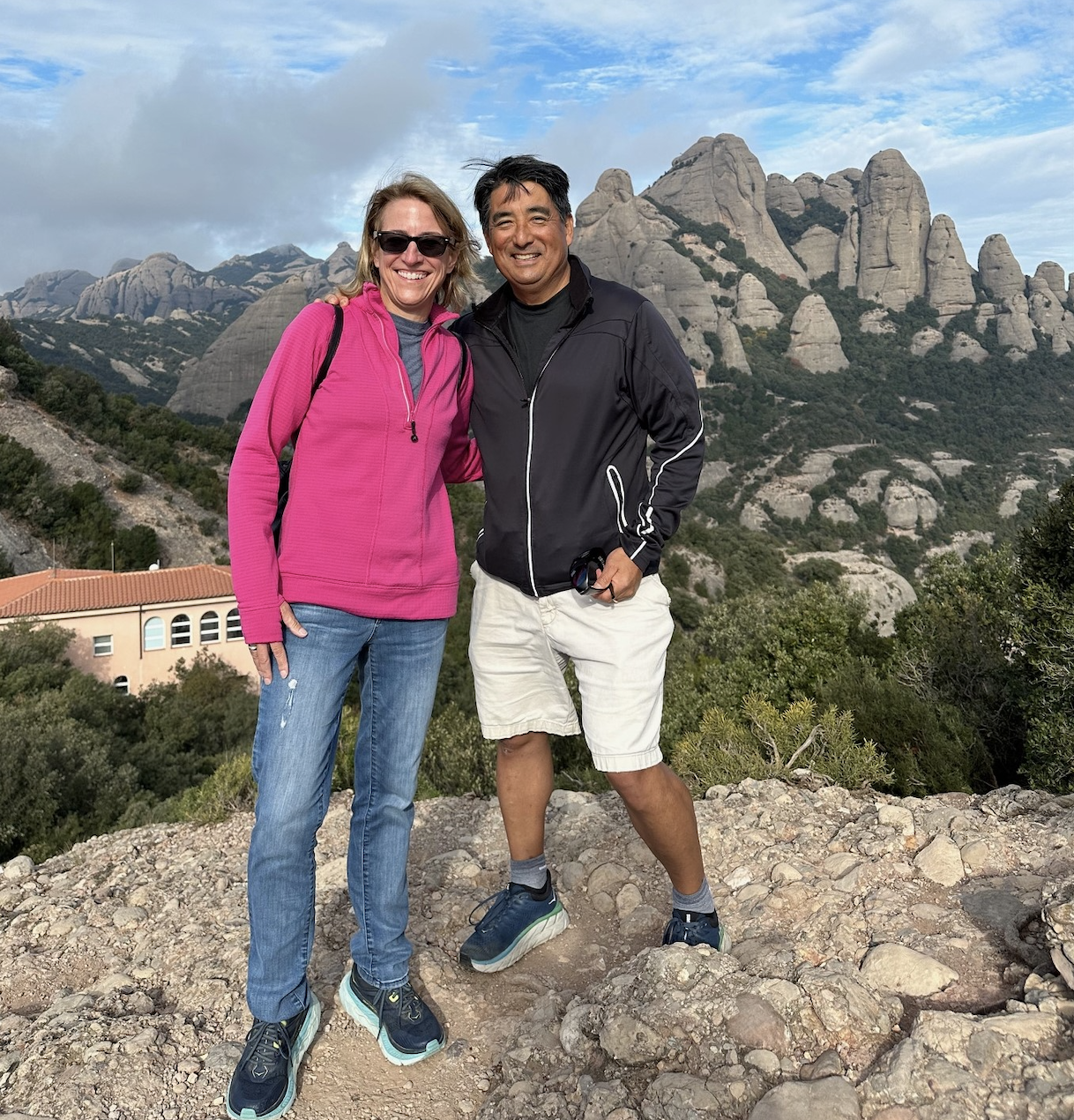
After retiring two years ago from long careers with UCSB then Amgen, (I wonder how many of our CVMM teammates have Amgen ties – a lot I think!) Krish now divides her time between California and Colorado. Outside of swimming, she loves hiking, backpacking, and snowshoeing. She is a docent at the very awesome Ronald Reagan Museum. (I will be going to see the new exhibit soon – it’s called Defending America and the Galaxy – Star Wars and SDI.) She also spends time supporting the Jewel Levine Foundation, a local foundation supporting those fighting serious medical challenges. Our club is no stranger to that, so thanks to Krish and all of those working to make a difference. Krish’s two children are grown, and she and her husband are empty nesters except for their rescue Rottweiler. “Except for their Rottweiler” is kind of a funny phrase. A 100-pound Rottweiler is no small presence in a home.
We are happy to have Krish as part of CVMM. She said that even Steve, her not-yet-a-CVMM-teammate-even-though-he’s-done-his-share-of-triathlons husband, recognizes that her new swim crew seems to be more like a family. I know there are many of us who think that is exactly right. And Steve, there’s always room for one more! We are happy to have you on our team and in our family, Krish! Keep it up, and thanks for letting us feature you in our latest Who’s In That Lane!
To see previous Who’s In That Lane pieces, please click here.
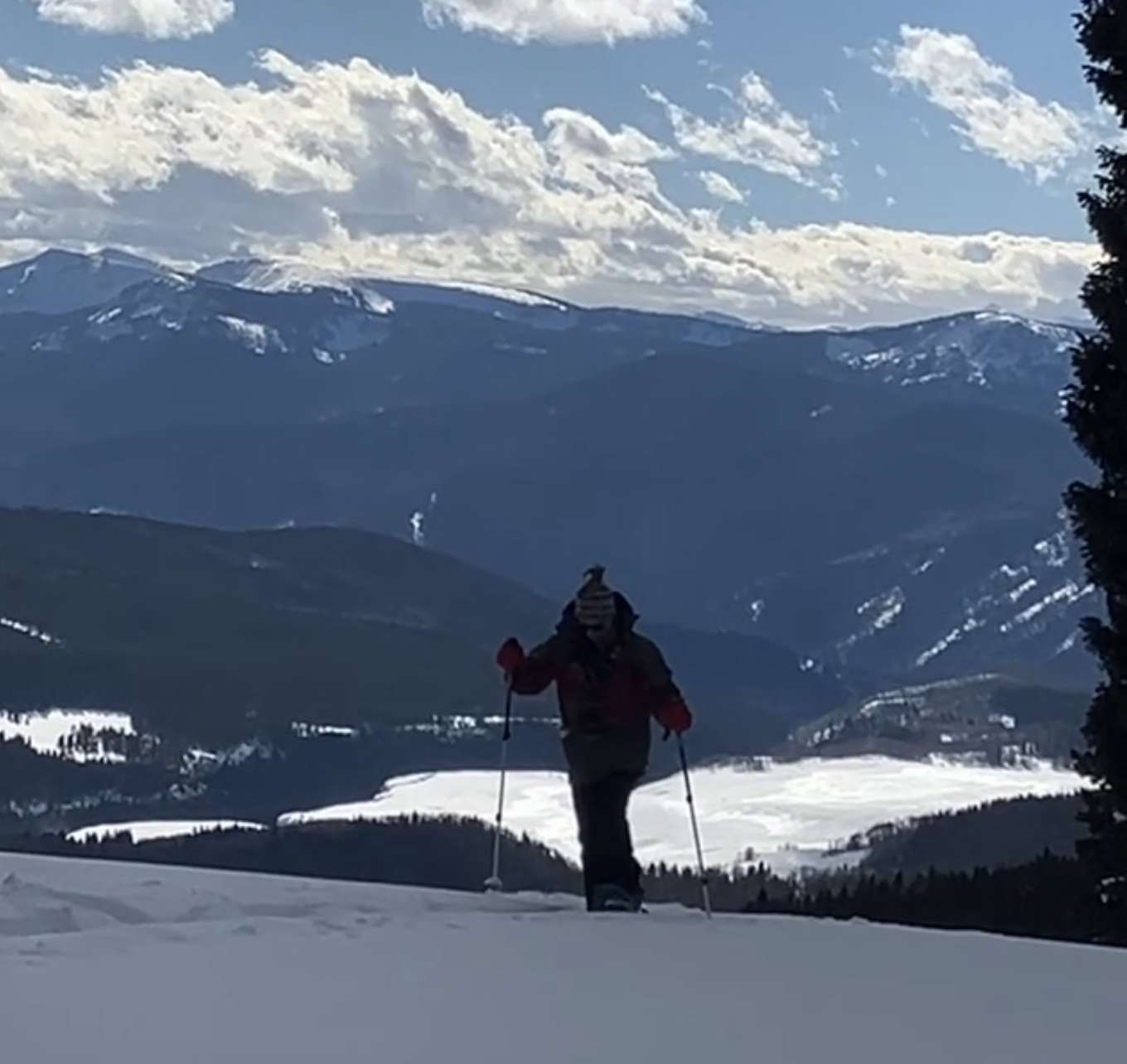
One of the unexpected opportunities of being my age is that finally, somebody might tell me that I am an “old soul.” It’s not something I heard growing up, or really, ever. Being viewed as an old soul means that people think you have wisdom far beyond what you should have at your age. Maybe I’m finally an old soul, not because I’m so advanced or precociously wise, but just because I’m so old! Maybe being old, even if I’m not wiser than my years, gives me an Old Soul Free Pass. I’ll take it either way! Some people believe that wisdom emanates from experiences in your life, others believe some humans are born with it or acquire it way more quickly than others, and some believe that wisdom is somehow passed down from humans from previous generations who learned key lessons. Call it evolution, call it spirituality, or call it what you want, I believe it is real.
My youngest son Dawson has that old soul vibe to him. Some of the ways I see it are how peer pressure, and worrying about what others think, is not really a thing for him. I see it in how he is so often sure of what he wants and the path he wants to take. And I see it in the way he listens to others and is constantly looking to learn from them.
I was thinking about all of this because my youngest son/old soul Dawson came home on Friday from his four-month adventure in Japan. Therefore, Friday was a spectacular day. I got to pick up Dawson at LAX. Twenty minutes after walking out of the airport, he was enjoying a Double-Double and a chocolate shake from In-n-Out. Welcome back to America!
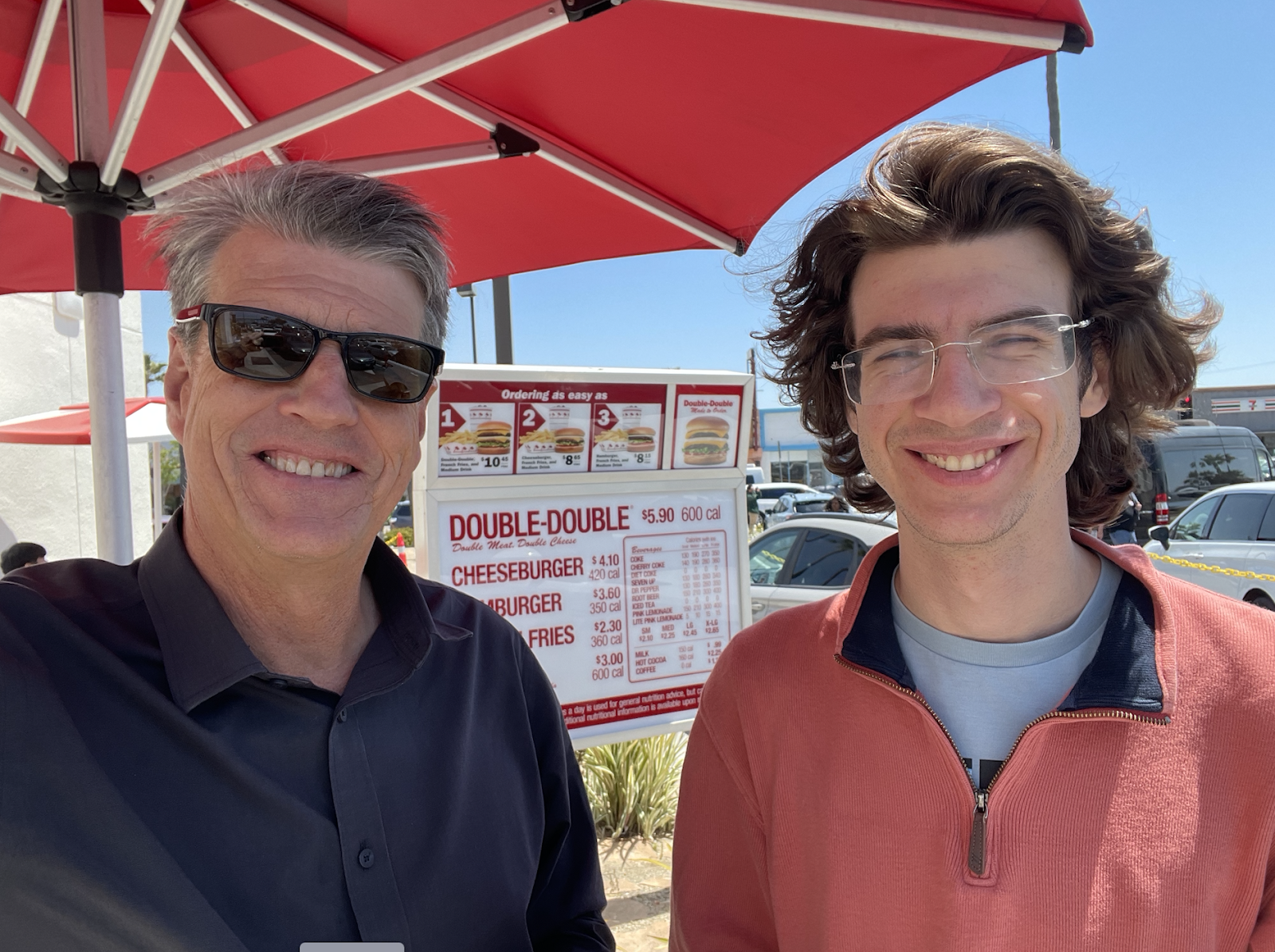
We did visit him in Tokyo back in February, and we had frequent FaceTime conversations with him while he was there, but it is so good to see him in person and at home. He returns to college for a summer field session (a project-based graduation requirement at the very awesome Colorado School of Mines – Go Orediggers!), then he comes back home for a few weeks, then he heads back for his senior year. So, we are making the most of our time together, chatting and laughing between his visits from friends and his crazy jet-lag-influenced sleeping patterns. We were eating dinner together this week (Dawson’s requested menu – filet mignon on the Big Green Egg, Dawson’s Roasted Potatoes, and Sauteed Broccoli – recipes at the end of the post). I love great food and even better dinner conversations, and this dinner met both of those criteria.
During dinner, I asked Dawson whether he thought that his extended time in Japan and all of his experiences there fundamentally changed him. We all talked about what it means to be fundamentally changed – some kind of personality change, a change in your belief system, or maybe a change in your life’s direction. After thinking and discussing, he said that his experiences in Japan did not do that for him, at least not yet. I probably should ask this question again in a year or so. He did say that he felt that it helped him to learn a great deal more about himself and to gain confidence in himself. He traveled to and through Japan, alone in many cases, dealt with all of the decisions and uncertainties that come with travel, concocted plans, adapted those plans when they went awry, and found his way in a country where English speakers are hard to come by. He also said he gained an appreciation for a remarkable culture very different from how he grew up, and those broadened horizons will stay a part of him throughout his life. All of that, and he made new friends from Temple University (Go Owls!), the school that runs the Tokyo campus.
Pretty good stuff right there. And isn’t that what travel is supposed to do? Sometimes, it’s hard to think about the vast world and worlds beyond ourselves. We all have so much going on in our lives. We have to deliberately do something to get us outside of our lives and learn about others. It was the great philosopher Ferris Bueller who said, “Life moves pretty fast. If you don’t stop and look around once in a while, you could miss it.” And looking around means more than just making a snap judgment based on what things look like compared to what you are used to. We cannot help but see others through our lenses, and those lenses are often clouded with a true lack of understanding. And sometimes, even when there is strong evidence countering what we have believed for years, we fear a tectonic shift in our thinking. Truly looking around requires us to make a sincere effort to take off those lenses and face those fears.
It was just five centuries ago when another great philosopher (also a pretty darn good astronomer and mathematician) figured out that earth was not the center of the solar system. Nicholaus Copernicus actually figured it all out 36 years before he published, but he waited until the end of his life to share his discovery and his truth, as he was pretty sure he would be imprisoned or killed for findings that pretty much destroyed everything about what humans thought they knew about earth, the sun, the planets, and the stars. Good call, Nick. It’s just one more instance of book banning as a futile effort to prevent change. In the last five years or so, it seems like I’m seeing too many places in America that are using those same 16th century philosophies, seeking to keep ideas they don’t like off of book shelves and out of people’s heads. As Ray Bradbury said in Fahrenheit 451, “There is more than one way to burn a book. And the world is full of people running about with lit matches.”
But if we want a world where people, nations, and cultures better understand each other, we need to keep those matches away from ideas that matter. We need ideas and experiences in our lives that encourage us to look beyond ourselves and our own belief systems. For all of the hopes and dreams of technology, social media has pretty much squashed our ability to see ideas and philosophies that differ from our own. We have to take initiative to expose ourselves to those different ideas and philosophies. We can do that through books, through conversations, and yes, through travel.
That’s why I’m so thrilled that Dawson took the time to travel. Although going overseas is a great opportunity, it is not an easy decision to make. It’s usually way easier to stay where you are, get the things done that need to be done, and be with the people you love to be with. And there’s nothing wrong with the easy route. But my wish for all of us is that we find ways and transcend the demands of everyday life, and find ways to travel, whether through books, conversations, or actual excursions, to get to know people and places unknown. We don’t have to boldly go where no man has gone before, but as often as we can, we should try to do some interacting and thinking that is outside of our circle of comfort.
I love Mark Twain’s thoughts on most things, except when he offends me. (I laughed while writing that last sentence.) On the topic of travel leading to greater understanding, he said, “Travel is fatal to prejudice, bigotry, and narrow-mindedness, and many of our people need it sorely on these accounts. Broad, wholesome, charitable views of men and things cannot be acquired by vegetating in one little corner of the earth all one’s lifetime.”
Exactly, Samuel.
So here’s to changing the world by learning about others. Here’s to making a difference in our world by doing our best to understand other cultures. Here’s to ideas, good and bad, seeing the light of day. And here’s to all of us, by seeking out learning and getting outside of our circle of comfort, becoming old souls and wise beyond our years. It’s never too late.
If you’re not on the mailing list, you’re missing out. Not only will I let you know when my blog posts come out, but you will get my once-a-month-subscribers-only message. I’ve put out three Mike’s Mid-Month Messages so far. I share what I’m cooking, what I’m watching, what I’m reading, and other news that had a profound impact on me. Thanks to all who let me know you appreciated it. If you’re interested, please click here
Post #107 on www.drmdmatthews.com
Notes
I cut this out of the post, as it was getting a little long, so for those of you who read the notes (and you’re awesome for sticking with me!), here’s some bonus content. I remember in my 1982-83 year abroad, when the Berlin Wall and the Iron Curtain were still very much intact, I spent quite a bit of time in East Germany, speaking with professors and other college students. I walked away with a strong disdain and healthy fear of totalitarian governments (Animal Farm is spot on), but also with a sense of respect and appreciation for ordinary citizens, who had no source of reliable worldwide information, who appreciated having their basic needs taken care of, who feared their government but would never say so, and who were all surprised to hear my version of life in the United States, which was not nearly as horrible as they had been taught.
A few others thoughts . . .
The Church did ban Copernicus’s book, and they later punished Galileo for saying Copernicus was right. (Though after much consideration, the Catholic Church did officially clear Galileo of all wrongdoing in 1992.)
This is my Tokyo Blog Post, posted after Jill and I returned from visiting Dawson in Japan.
And here are the recipes for the dinner: Steak, Dawson’s Potatoes, and Sauteed Veggies
Finally, today, May 4, 2024, would have been my son Sean’s 31st birthday. I think about him every day, but I sure would have enjoyed celebrating with him today. Here’s my post on him from 2022.